



Campus violence (bullying) and cyber-bullying in primary and secondary schools occur from time to time in our country, and the situation is becoming more and more serious, which is highly concerned by the whole society and highly valued by the party and the state. As the only key research base of humanities and social sciences of the Ministry of Education in the field of curriculum and instruction, the Institute of Curriculum and Instruction of East China Normal University pays attention to students’ development and adheres to the professional belief of "For Curriculum, For Students, For the Future". Attach importance to the theoretical research that affects students’ learning and development, and is committed to providing professional support for national curriculum decision-making, school education practice, students' learning and development.
Recently, Associate Professor Lei Hao and his research team published two SSCI papers on the topic of student development-campus bullying and cyber bullying, and had a profound and meaningful sharing of the relevant research results on international platforms.


△ Lei Hao
Doctor / Associate Professor
Institute of Curriculum and Instruction, East China Normal University



In December 2017, 11 departments, including the Ministry of Education, jointly issued the “Plan for Strengthening the Comprehensive Management of Bullying Among Primary and Middle School Students”. It makes clear provisions on the attribution of the rights and responsibilities of the incident, the measures to deal with bullying in different situations, and the establishment of a sound feedback and reporting mechanism for campus bullying and campus violence, so as to further clarify the prevention and control requirements and specific measures of campus safety.
However, does it mean that bullying on campus is becoming more and more serious as it is increasingly concerned by the public, and valued by the state?
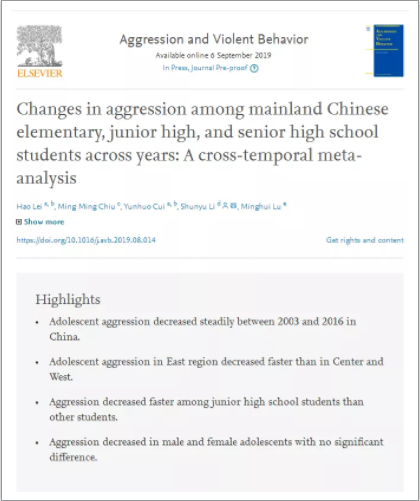
In order to answer the question, Associate Professor Lei Hao and his research team used the method of cross-sectional historical meta-analysis to analyze the development trend of bullying behavior of 87319 primary and middle school students in mainland China in the past 14 years, and explore the regulatory factors that affect the changes of bullying behavior of primary and middle school students.

The study found that:
The level of bullying behavior of primary and middle school students in mainland China shows a significant downward trend.
The level of bullying behavior of students in different regions showed a downward trend, and there was no significant difference.
Compared with primary and high school students, the level of bullying behavior of junior high school students decreased most significantly.
The level of bullying behavior of male and female students also showed a downward trend, but there was no significant difference.

The results show that the level of bullying behavior of primary and middle school students in mainland China has shown a downward trend in the past 14 years, especially in junior middle school.

This study also believes that although the country and society pay close attention to school bullying, it is not caused by the change in the severity of bullying, but may be caused by the high frequency of bullying and the wide publicity of social media.




Cyber bullying is a special form of bullying in the information society, which is universal in countries all over the world, and young students suffering from cyber bullying has become an important factor affecting social development.

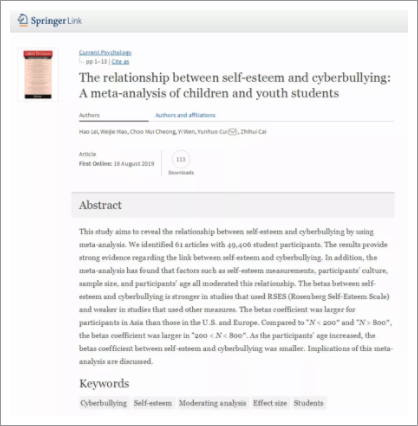
Associate Professor Lei Hao and his research team pay attention to the forming factors of cyber-bullying behavior, and propose that “self-esteem is an important factor leading to students’ cyber-bullying behavior”. However, the social bonding theory, the threatened egotism theory and related empirical studies are controversial on whether self-esteem inhibits or promotes students’ cyber-bullying behavior.

Thus, Associate Professor Lei Hao and his research team used the method of meta-analysis to analyze the impact of self-esteem on students' cyber-bullying behavior based on a sample of 49406 students around the world.

The results show that self-esteem has a significant inhibitory effect on students’ cyber-bullying behavior, and there are significant differences in the inhibitory effect on cyber-bullying behavior of students in different regions and genders.

The results also show that self-esteem education should be carried out for students of different regions and genders in the future in order to control the incidence and destructiveness of cyber bullying.


 Address: 3663 Zhongshan North Road, Shanghai
 Email: ecnuici@163.com
 电话:021-32526084