




Punya Mishra
Arizona State University

Title: TPACK and beyond: Designing technology and education from artifacts to culture
For the original video: Please scan the QR code and login

We publish this report with the permission of Prof. Punya for the use of scholarly communications only.


01. What is the content of TPACK framework? Why should we pay attention to it? Why is it so important?

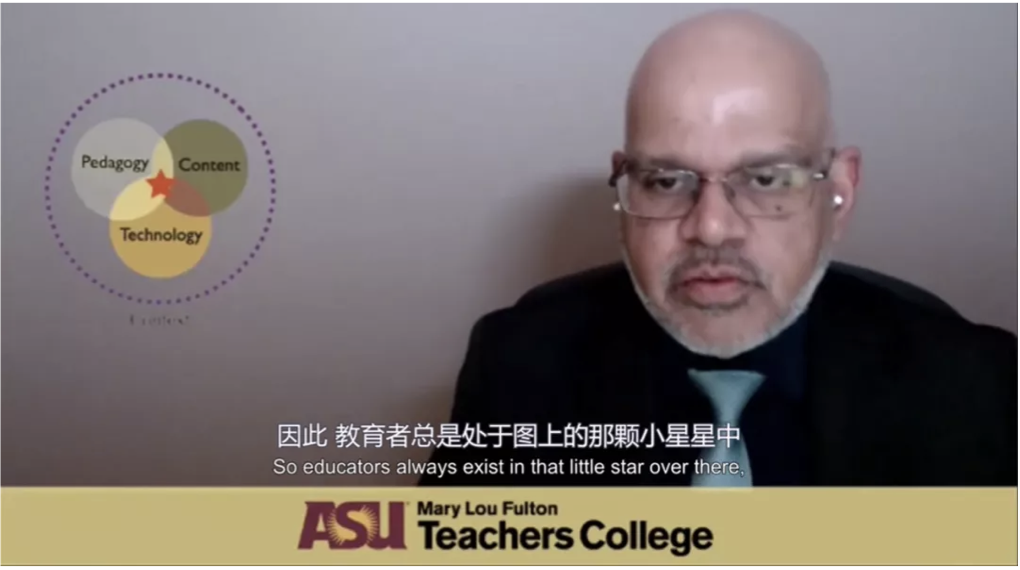
So, what is TPACK framework? In short, the TPACK framework is self-evident at some levels, and I’m sure good teachers and educators can understand it. They think that good instruction depends on specific content, which can be science, mathematics, music, literature and so on. The method of conveying the content is the teaching method, and teachers can choose to use group discussion, online teaching or whole class teaching. Finally, it is about the tool used to convey knowledge-technology.
It is important for us to understand that instruction is always at the intersection of what we want to teach, the methods we use to teach it, and the tools we use to instantiate or facilitate learning. Therefore, educators are always the little star on the picture, that is, the intersection of technology, teaching methods and content.


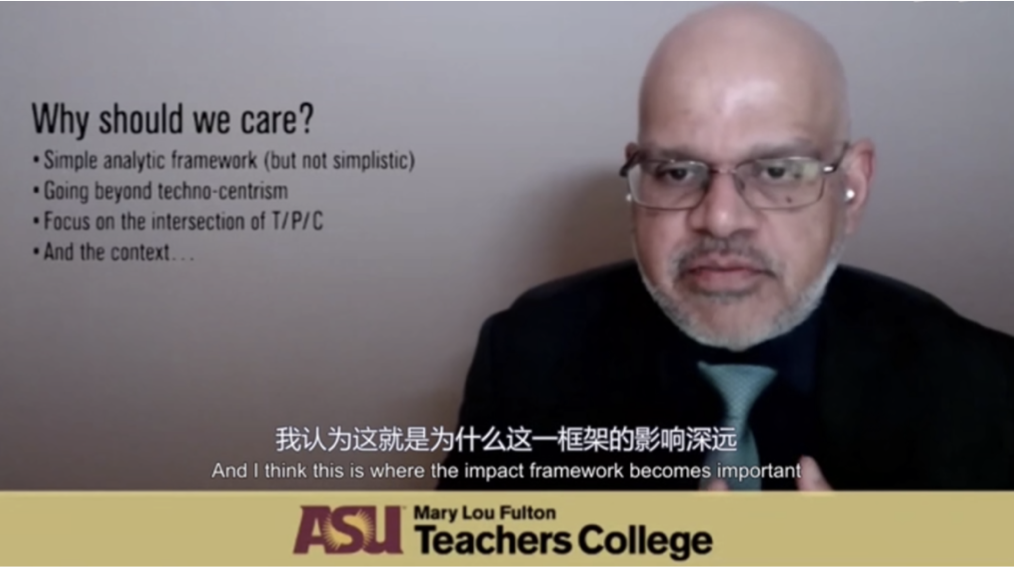
It is importance in that the TPACK framework provides us with an analytical framework to think about the decisions we make in teaching and learning. Any framework we create is a representation of reality, that is, an abstraction of reality, which means that, in essence, it will mislead us in some way. The question becomes whether this representation is helpful to us. I think this is why the impact of this framework is far-reaching, although it is very simple, it does not simplify the problem, and it respects the complexity of using technology as the tool of teaching.
Second, I think the reason why we should pay attention to the framework is that the TPACK framework takes us beyond the scope of technology centralism. It goes beyond simply focusing on technology, and it says it’s not just about technology. Yes, it's about technology, technology is an important part, but perhaps more importantly, what we want students to learn and what methods to use.


02. How can we help teachers become creative users of technology?


Recently, I often ask myself a question: what do we ignore when we talk about TPACK? The question is about why education has not changed, even if we know the great potential of technology, why do we still adopt classroom structures and education systems similar to those in the past? This led me to go beyond the TPACK framework and think of education as a system designed by us. It is either specially designed and planned, or it is only designed according to the historical situation.
Everything is constructed by us. This is what Yong and I have been talking about, and I think Yong will talk about this in this section. If we think that the education system does not produce the results we want, if we think that our students are not creative thinkers, if we think that our students are not entrepreneurs, if we think that our students do not have critical thinking, if we think that our students will only learn by rote, the reason is that we designed the whole system in this way, we designed them like this. I believe, as educators, we must realize and acknowledge that the existing system is designed by us, therefore, we can start to think about how to design new forms of instruction.

03. When we talk about designing our education, what exactly are we designing?

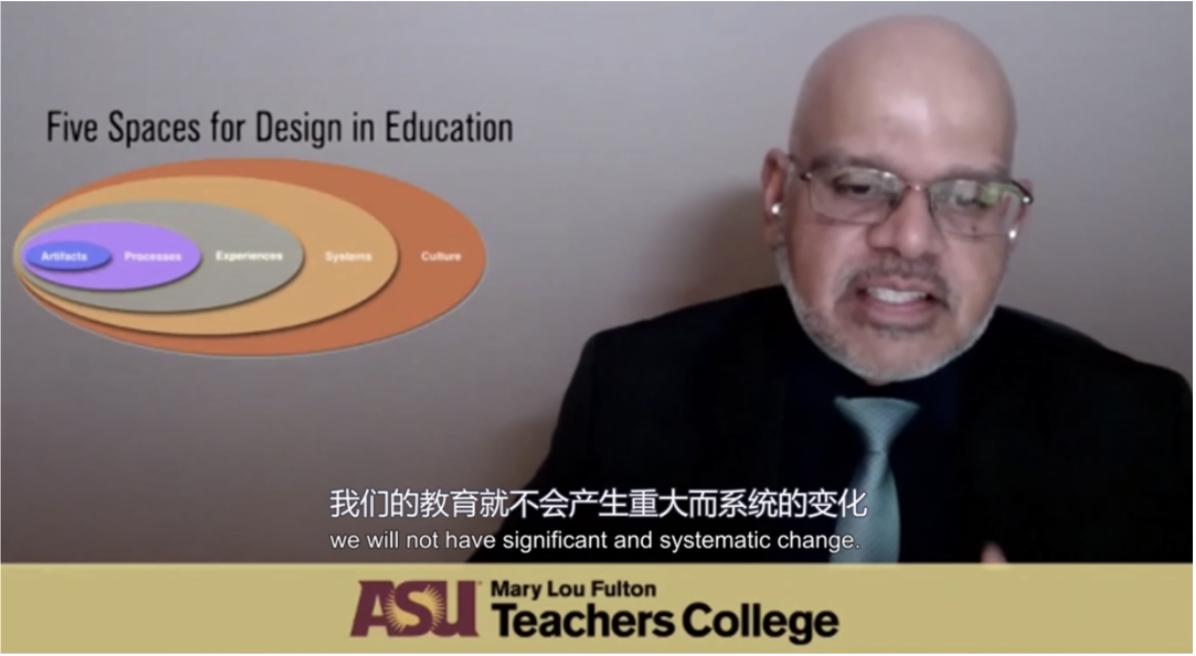
This involves what I am currently doing, which we call the five spaces for design framework. When we start to think about the role of design, we realize that we can design many aspects of education, such as Apps, curriculum planning, student experience, evaluation system, and broader culture. These designs are very different from each other. Therefore, we need to think about design more wisely. These are the five design spaces we proposed, including artifacts, processes, experiences, systems and culture.



When we understand the above five areas of education, we can return to the TPACK framework. I think the TPACK framework focuses on artifacts (technology), how students or teachers learn and use these technologies. Thus, in some ways, I think the TPACK framework is really doing a good job. However, I think it ignores the problems of system and culture. If we do not consider the broader system and culture, if we do not expect changes in technological tools, curriculum, etc., our education will not bring about significant and systematic changes.


04. The process of education is not a natural phenomenon, it is man-made

My favorite quotes about education says that “The process of education is not a natural phenomenon, it is man-made”. We make up these things to meet our goals and needs. I think students may ignore this, and students tend to think it is something imposed on them. This is a problem, because in this way they will not feel that they have autonomy in their own learning and development. Thus, what we need to do is to make it work better through innovation. I think it is very important that we not only learn things, but also think about how to make progress through learning.



At the end of my speech, I would like to say that the only way out for sustainable reform in education is for us to recognize its artificial nature. We always take it for granted, and we are always talking about when we can get back to the “normal”. I think China has reached the normal state after COVID-19 to some extent, while the rest of the world is still working hard. But this normal state is constructed by people, it is not like the “normal” of a tree, the normal state of the tree is the natural state. We created all this. Only when we interact and design in these five spaces can our life be better than when we enter that space. I am looking forward to interact with you and looking forward to the next report. That’s the end of my report. Thank you very much.



 Address: 3663 Zhongshan North Road, Shanghai
 Email: ecnuici@163.com
 电话:021-32526084