




Professor Wang Muhua
Northeast Normal University

Title: From Constructivism to Connectivism: Future Trends of Curriculum Development
For the original video: Please scan the QR code and login

We publish this report with the permission of Prof. Wang Muhua for the use of scholarly communications only.

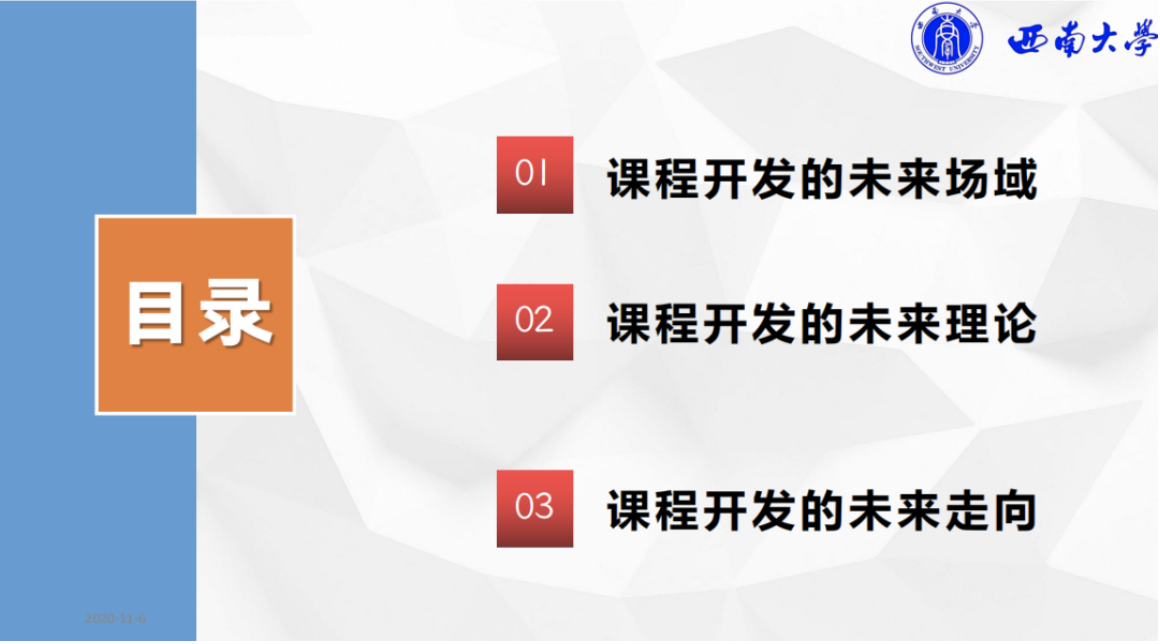
Today, I would like to share with you three issues related to curriculum development: the future field of curriculum development, the future theory of curriculum development, the future direction of curriculum development.


01. The future field of curriculum development

When it comes to the future field of curriculum development, we need to think about two reports. The one is “What Schools for the Future”, which presented typical cases of the practice of school education. The other report is “Back to the Future of Education” released in September this year.

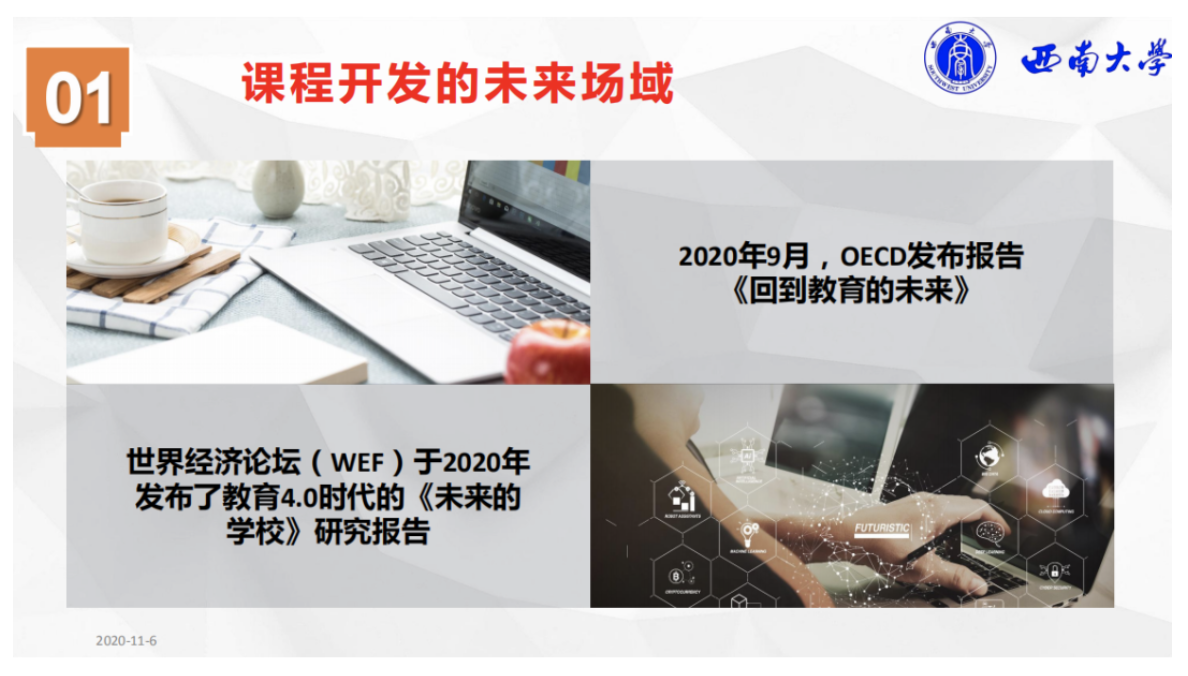

In the latest report, OECD shared four scenarios for the future education. These four scenarios are school extended, education outsourced, school as learning hubs and learn-as-you-go. These are four prospects for future education from OECD.





At the same time, the World Economic Forum also talked about future education and future learning, the forum proposed four core abilities and four kinds of learning of students for the future.



They attached great importance to students’ global citizenship skills, innovative creative skills, technology-related skills and interpersonal skills. Professor Zhao Yong made a discussion on the issue of creation this morning, which is also a great concern in the future education.

Based on the four abilities, they talked about the way of learning in the future, which should be a personalized autonomous learning model, as well as barrier-free learning and inclusive learning, problem-based and collaborative learning, lifelong learning and student-led learning.

02. The future theory of curriculum development

The second issue we need to think about is the future theory of curriculum development. At present, the dominant theory of curriculum development is constructivism. However, when confronting the future, we need to shift from constructivism to connectionism. Today, I am not specifically talking about what constructivism is, I will briefly talk about the transition from constructivism to connectionism. There is an intermediary, which is structuralism. Generally speaking, judgment constructivism attaches great importance to individualism and emphasizes on the individual’s construction and understanding of knowledge.



Connectionism provides a holistic way of thinking, and here I provide you with a basic view of what connectionism is. In 2004, Siemens said that it was based on activity theory and social learning theory. It was put forward as “the learning theory of the digital age”. Today we are in the digital age, we believe that knowledge is distributed in the whole network and stored in different forms, which is the basic view of connectionism.



Connectionism views learning as multi-channel, multi-level and multi-subject. It stresses the establishment of a learning community, making use of the professional knowledge of educators and community members to build a regional knowledge network and cooperation system. Also, it emphasizes on learners’ reflective and metacognitive ability, and pay attention to students’ inquiry and experiential feedback.

03. The future direction of curriculum development

Based on the views of connectionism, we believe that the future curriculum development needs to consider four directions.

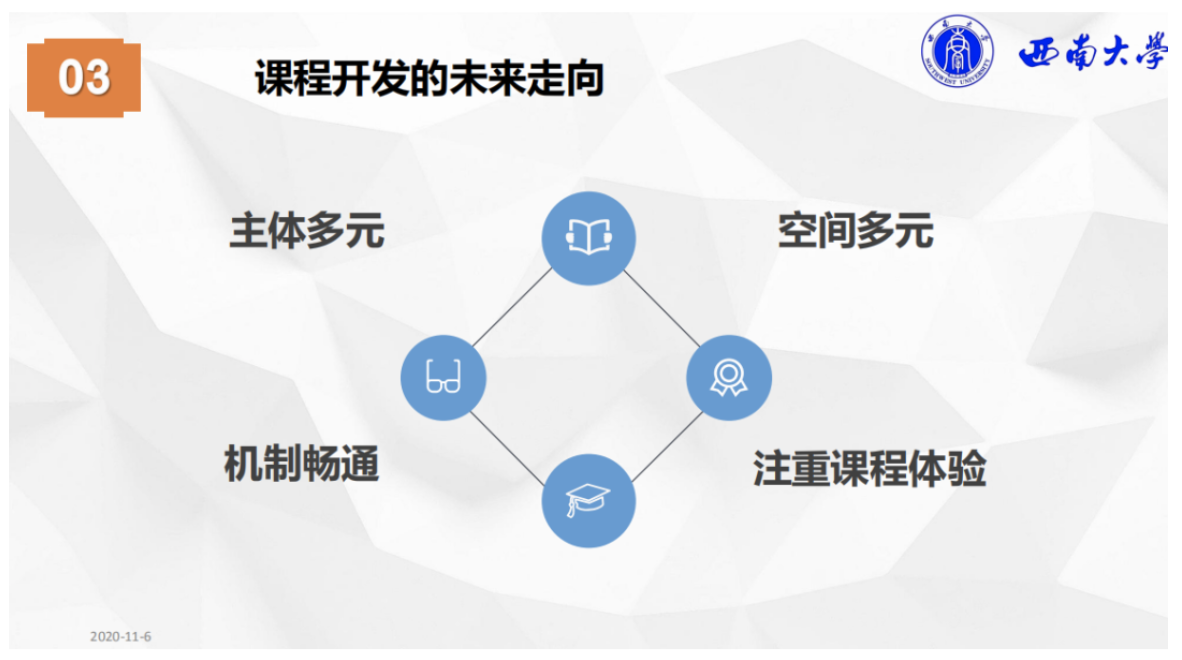

First, the subject of curriculum development should be diversified, it requires the participation and cooperation of multiple subjects, especially the extensive participation and cooperation among learning subjects. Second, the space of curriculum development should be diversified. Third, we need a flexible mechanism to develop curriculum, which means our schools, our communities, our society, need to cooperate very flexibly. At last, we are supposed to pay attention to curriculum experience of students, in that an individual student is a curriculum constructor, only through students’ experience can their literacy be actually developed.

 Address: 3663 Zhongshan North Road, Shanghai
 Email: ecnuici@163.com
 电话:021-32526084