





Professor Kirsti Lonka
University of Helsinki

Title: Phenomenal learning from Finland: How to promote future skills?
For the original video: Please scan the QR code and login

We publish this report with the permission of Prof. Kirsti Lonka for the use of scholarly communications only.

Hello everyone! I am very pleased to share with you the phenomenological learning in Finland and the way to improve the future skills of young people and teachers around the world.



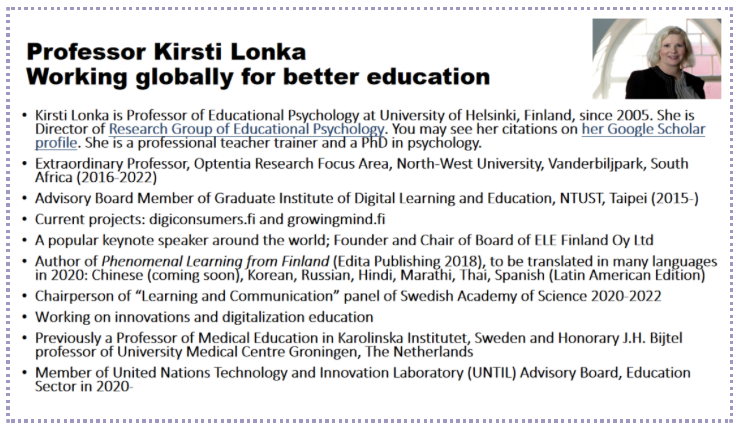
The next slide is a brief introduction of my personal experience. I have been a professor at the University of Helsinki since 2005, and I have been training teachers at different levels, I teach them psychology, communication and learning and motivation psychology.


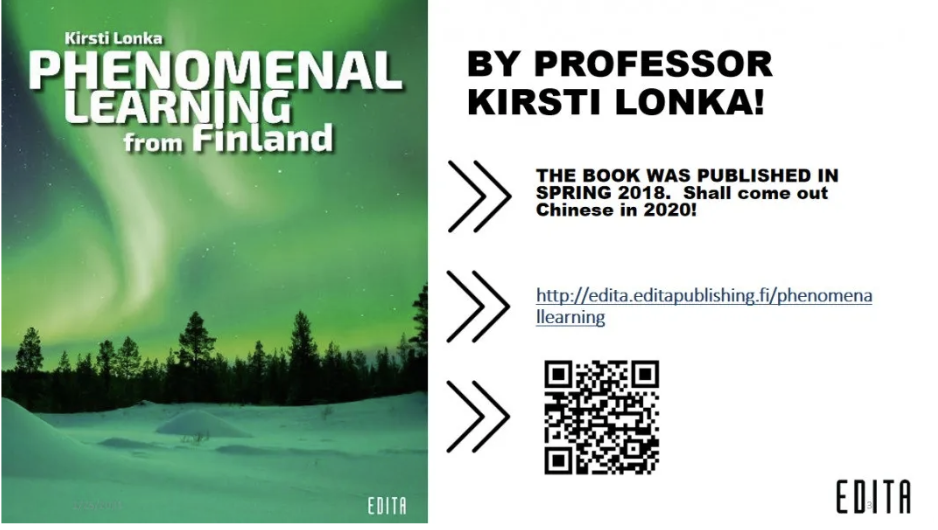
The next slide is about my book. The good news is that the book has been translated into Chinese and will be published soon. The English version of this book has been published in 2018, and I hope you will know more about these topics in the upcoming Chinese version.


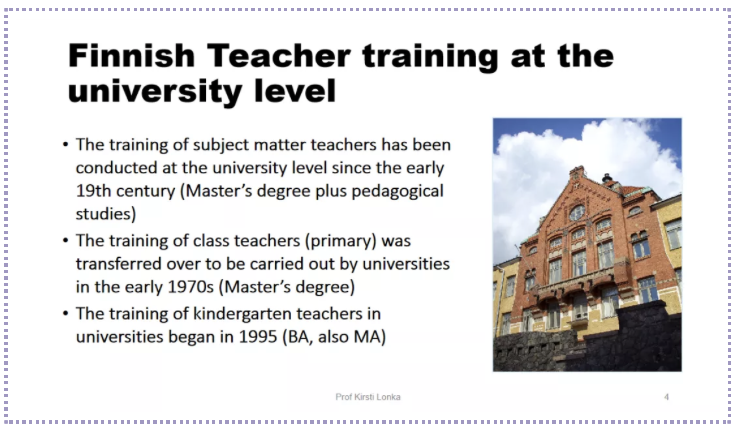
In the next slide, I briefly summarize the situation of our teacher education. Our training of subject matter teachers has been conducted at the university level since the early 19th century. It is worth mentioning that our training of class teachers (primary) was transferred over to be carried out by universities in the early 1970s. In addition, the training of kindergarten teachers in universities began in 1995.


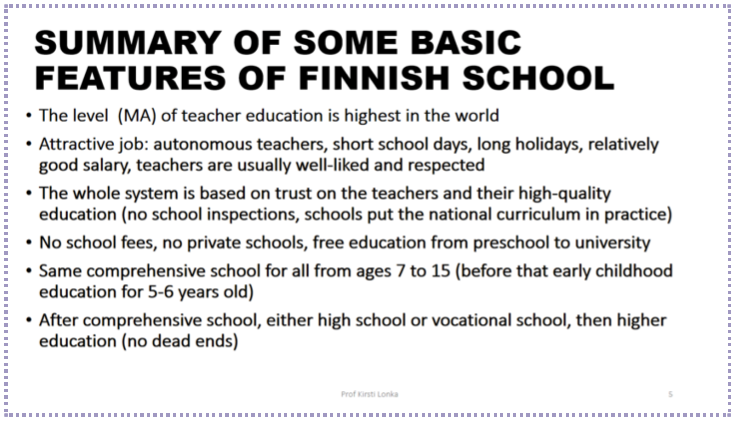
In the next slide, I summarize several basic characteristics of Finnish schools. We have the highest level of teacher education in the world. We have too many people applying to be teachers, but the occupation is extremely limited. Our teachers have autonomy, we trust them. Teachers are respected and loved in our culture and community. The whole system is based on trust and high-quality education of teachers. Thus, we don’t have any school inspection.


In the next slide, I’m going to talk about the reform 2016 and our latest trends.



In Finland, we are always concerned about whether our teaching practice is alienating students. This is why we think it is very important in the context of the continuous development of digitization. My research group and I have done a lot of research in this area. We have been observing how young people use digital media, the Internet and electronic devices. We found that students who learn how to use mobile phones meaningfully tend to get good grades and are better able to devote themselves to school. This is why we feel that the modernization of education is quite important, and we should always insist on doing so.



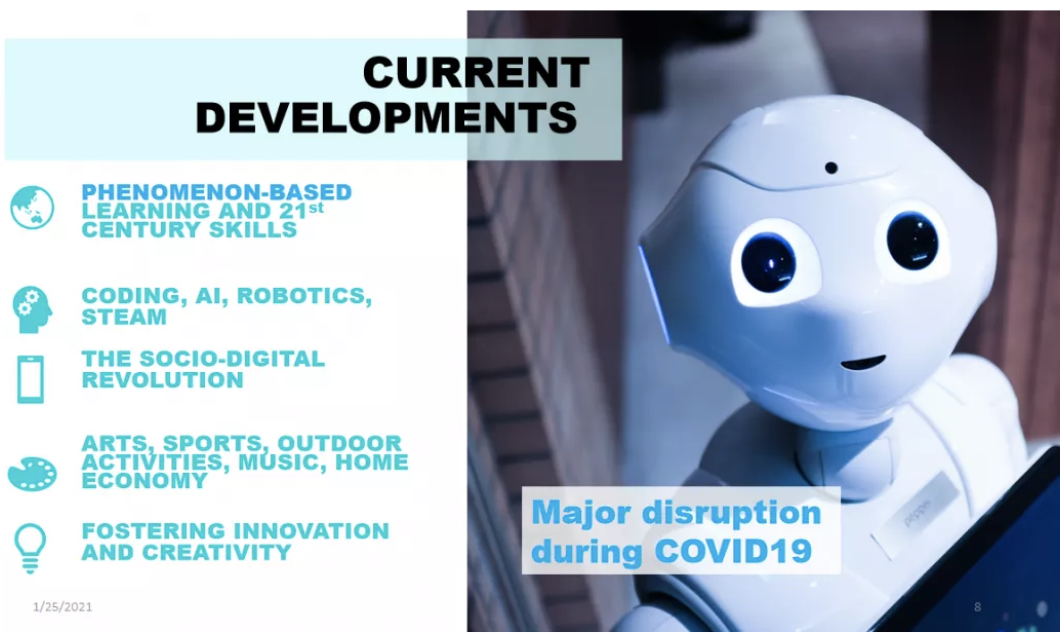
I list some of our recent developments. I will focus on phenomenal learning and skills in 21st century, which is also the focus of this report. The new curriculum requires us to have one or two interdisciplinary projects in addition to subject teaching every year. The social digital revolution further digitized our education during the COVID-19 epidemic, we call social digital participation. We need to train students to feel that this is a natural practice for young people.

What is special about Finnish education is that we have compulsory disciplines such as art, sports, outdoor activities, music and even home economy. Now we are mainly focused on cultivating innovation and creativity. The COVID-19 epidemic disrupted our education, however, we learned more in those three months than in the past 15 years. If it hadn’t been for this epidemic, I wouldn’t have made the report in this way.


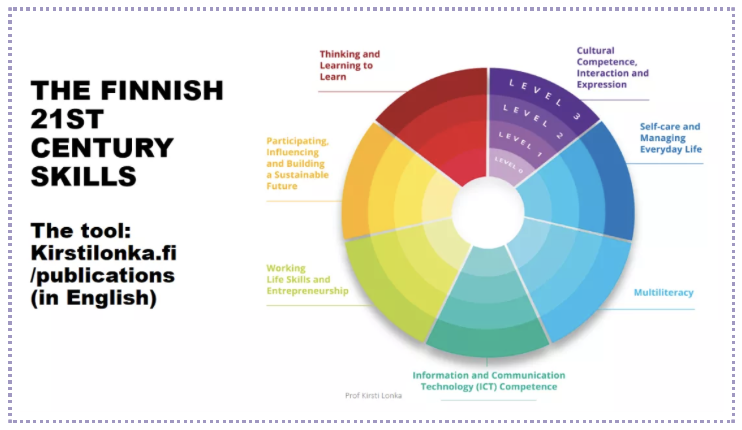
In the next slide, I show the Finnish 21st century skills. The skill in red, thinking and learning to learn, critical thinking, innovative thinking, reasoning, this is the most important of all skills. What’s more, students need to learn how to evaluate their own studies. They have peer evaluation, metacognition, that is, to evaluate your own understanding. Of course, there are ICT skills, self-care and managing everyday life.


Then, what is phenomenal learning? Phenomenal learning is different from problem-based learning. For example, problem-based learning starts with a single case, but phenomenal learning starts within a larger phenomenon.



In the next slide, I describe the typical characteristics of phenomenal learning. It takes advantage of the natural curiosity of children and young people. Thus, there may be a given theme in the school, like a forest close to our hearts, and then children and young people in their own classrooms, with their teachers, can begin to define what phenomena they are going to explore. This is a good way to integrate 21st century skills or cross-cutting abilities in learning.



We need to involve learners in a variety of environments, and integrate physical environment, virtual environment, social, mobile and psychological learning space.



The next slide shows how our team develops a participatory learning environment for future teachers. In this clip you can see a short film, which contains how the interaction in mass education changes so that students no longer have to sit in rows. We are now carrying out the teacher education reform in 2020, because we need to start reforming teacher education, and then we can reform schools.



I am very happy to share with you this topic, I hope you have a good day. I really hope that one day I can visit you in China. I learned a lot from you during my trip to China. We can learn from each other and develop the school together. Thank you very much for your attention.

 Address: 3663 Zhongshan North Road, Shanghai
 Email: ecnuici@163.com
 电话:021-32526084