




Dr. Wang Tao
The Institute of Curriculum and Instruction, East China Normal University

Title: Glocalized Competence: The New Normal of Global Education and Curriculum Development
For the original video: Please scan the QR code and login

We publish this report with the permission of Dr. Wang Tao for the use of scholarly communications only.



Good afternoon everyone, my name is Wang Tao, I am working at the Institute of Curriculum and Instruction. In Prof. Zhao’s report this morning, he talked about what competencies our students should possess. He mentioned international thinking and international consciousness. Meanwhile, Professor Wang Muhua and Professor Lyu Lijie both mentioned the concept of global literacy. I myself am doing research in this field. Today, I would like to share my understanding of multicultural education and international understanding education in the light of my own experience.

First of all, let’s take a look at the core concept in my report title, “Glocalized Competence”. This concept is originated from global competence. In my latest paper, I proposed a new concept, named “Glocalized Competence”, which is a combination of “Global” and “Local”.

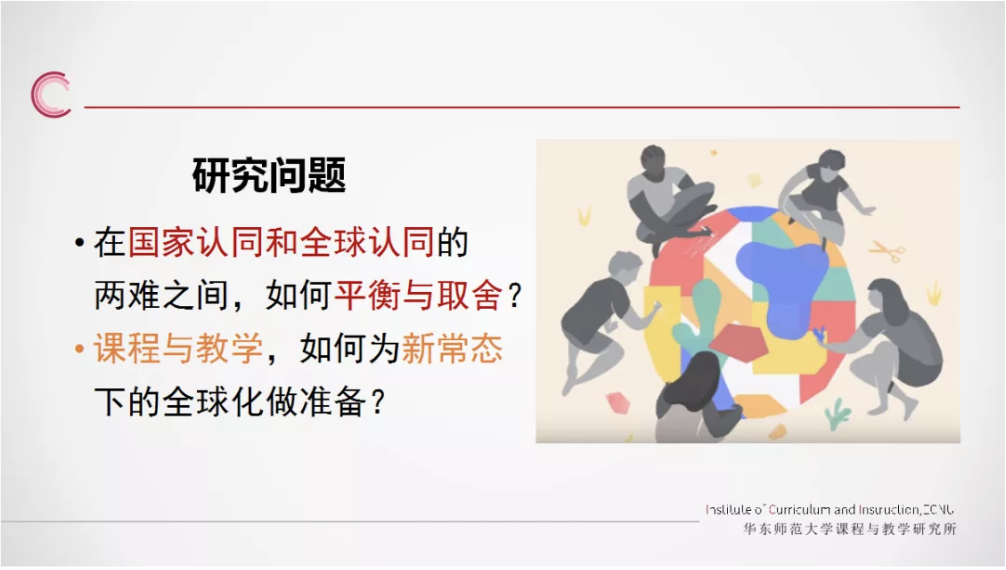

Specifically, I will mainly answer two questions in this report. the first question is how to balance the identity of the family and the identity of the world in the traditional international civic education. Second, how can we prepare for globalization in the new normal from the perspective of curriculum and instruction.

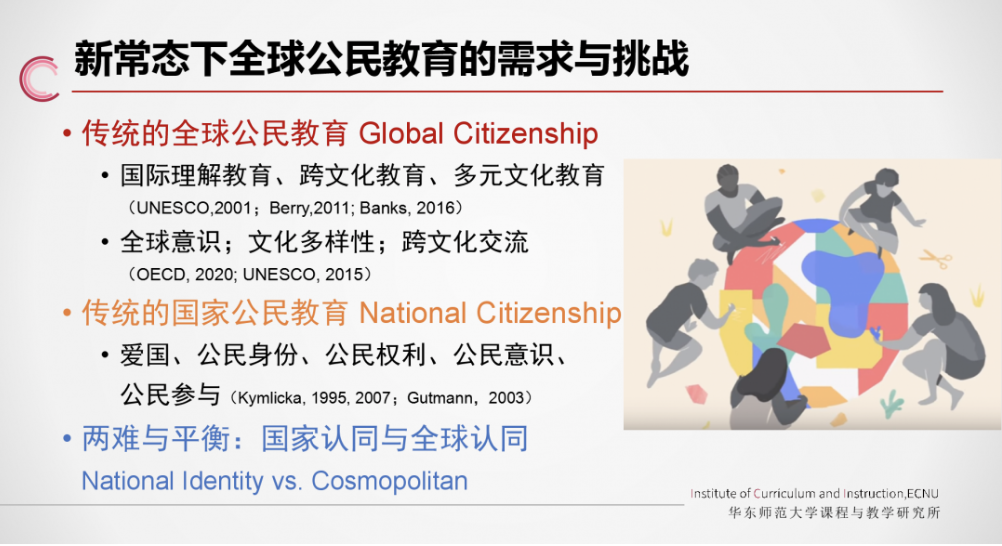

There is a classic dilemma in international civic education: when you are patriotic enough, you may be at odds with other countries. There is often a dilemma between the identity of our own country and that of the world. This is what we have discussed for a long time in international civic education, at least in the past two or three decades. Thus, the issue we consider is that in such an era, how should we cultivate students' global vision and global thinking?

In order to answer this question, I put forward the concept named “Glocalized Competence” after doing a series of text analysis and some empirical research. Let me try to explain the concept.

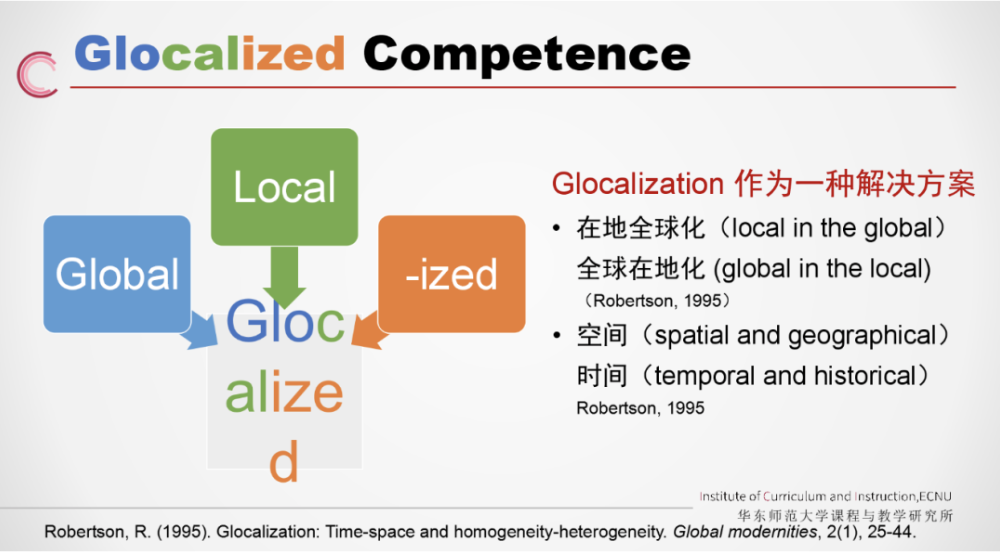

This concept consists of two parts: the first part is “local in the global”, which means as a local citizen, we live in the world, we live in the global village. The second part is “global in the local”, which means that when I go abroad, I need to learn to integrate into the local area and have a cultural dialogue with the local people.

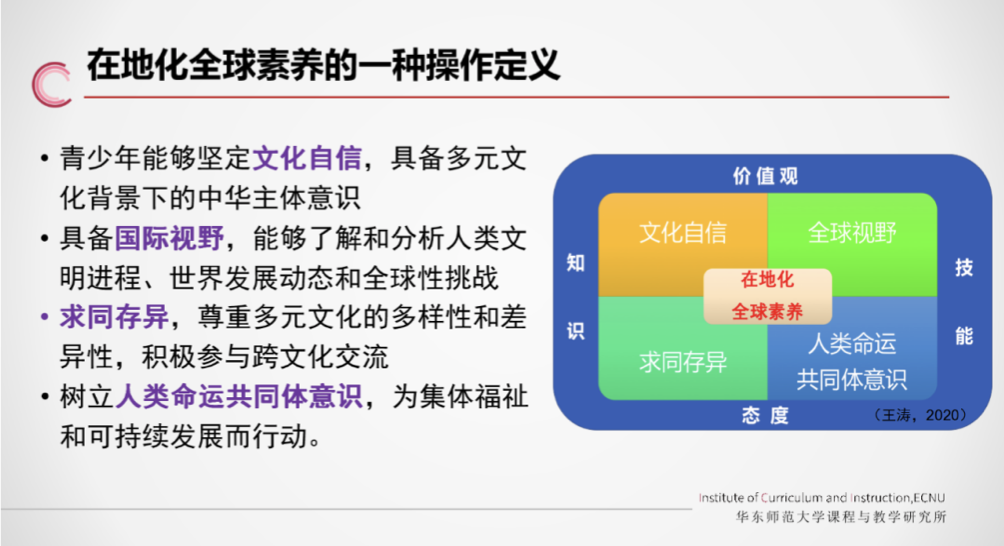

Based on this concept, let me talk about the framework. The first part is cultural confidence, the primary thing we should advocate is to understand our own culture and build up cultural confidence. The second part is international perspective, which generally refers to the understanding and reflection of cultures and related issues of other countries. The third part is to seek common ground while reserving differences. The fourth part is the consciousness of a community with a shared future for mankind, which is more important. In fact, when we educate and cultivate children, we hope that they will have a common concern for the fate of mankind.

Let’s talk about the issue of curriculum integration and its implementation. When it comes to curriculum integration, we often integrate international understanding education with certain disciplines. It seems that the education of international understanding is related to English, history and geography only. It doesn’t seem to have anything to do with math or Chinese. In fact, there are actually much more way to integrate the education of international understanding into our curriculum.

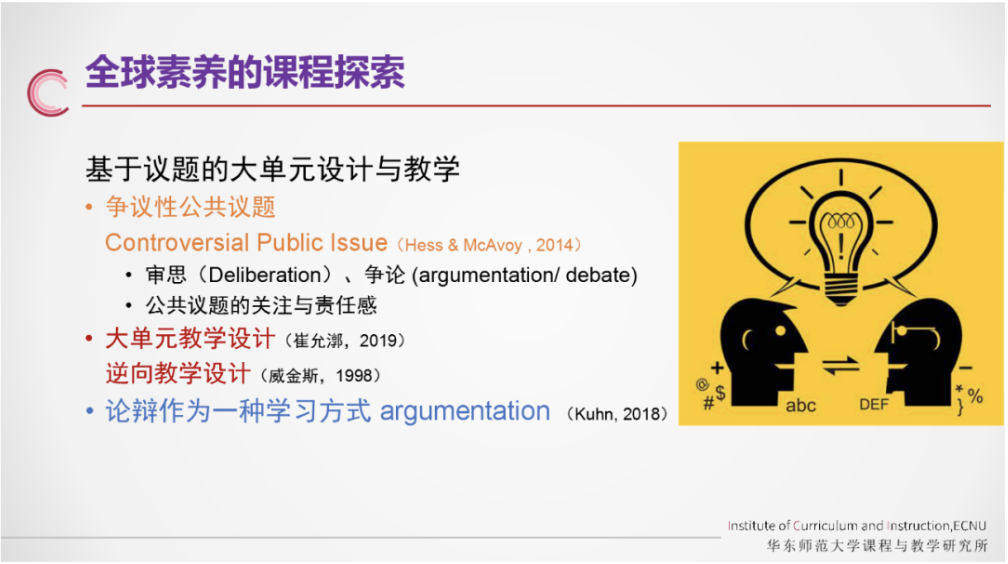

I will talk about my recent exploration. The main theory of this study is the discussion of controversial public issues. First of all, the issue should be controversial, why should it be controversial? Because in the dispute, it is easier for students to think, ponder, argue and understand each other’s point of view. At the same time, it must be a public issue, because we are doing civic education, and the public issue enable students, as citizens of a country and a social collective, to thinking as a citizen and debate as a citizen.


 Address: 3663 Zhongshan North Road, Shanghai
 Email: ecnuici@163.com
 电话:021-32526084