

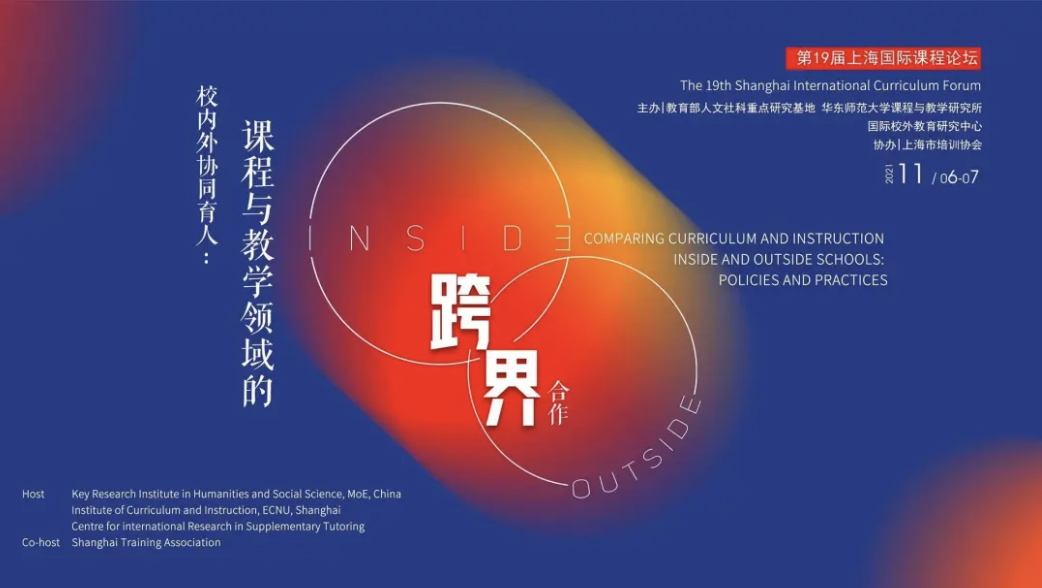

In order to promote the development of collaborative education inside and outside schools, and the standardized and orderly development of out-of-school training industry, The Centre for International Research in Supplementary Tutoring (CIRIST) of ICI, and Shanghai Training Association held a forum entitled “Comparing Curriculum and Instruction Inside and Outside Schools: Policies and Practices” from Nov. 6 to 7, 2021.


Associate Professor: Søren Christensen
Aarhus Universitet, Denmark

Content of the Report


The topic of my report today is “Shadow education in the Nordic countries: RoE special issue”.
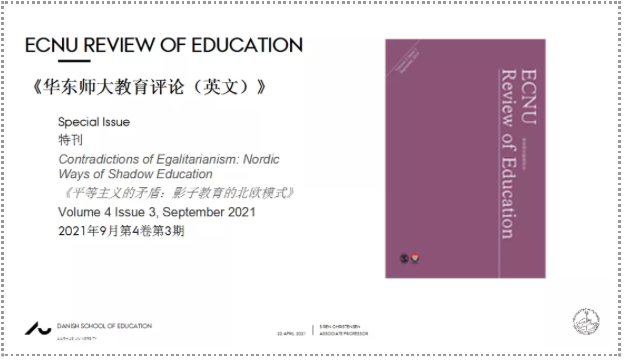
The research of shadow education led by Professor Mark Bray shows that although shadow education is more prominent in East Asia, it has now become a global phenomenon and is reflected in the global education system. It raises an important question: why we need to pay special attention to shadow education in Nordic countries? In other words: what is interesting or special about shadow education in Nordic countries? I think the article in the special issue of RoE can provide some insights to this question.


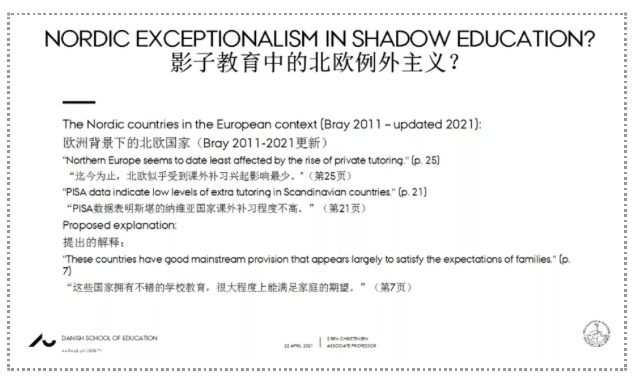
First, until recently, the Nordic education system was more resistant to shadow education than most other education systems in the world.


Secondly, our collaborative research shows that shadow education originated in the Nordic countries, or specifically, the unique history of Scandinavian countries (Denmark, Norway and Sweden).



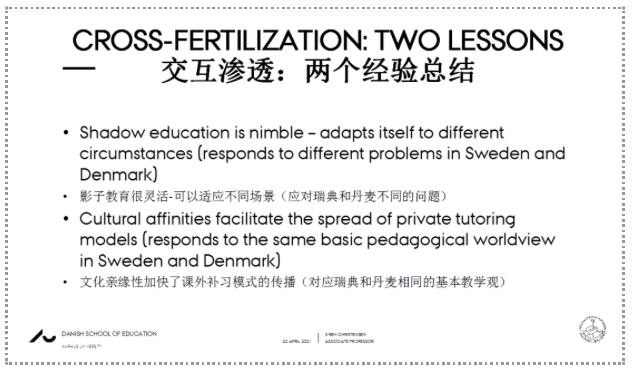
Two lessons can be learned from the brief history of shadow education in Scandinavia: first, shadow education is nimble-adapts itself to different circumstances; second, cultural affinity is also very important in the spread of shadow education.


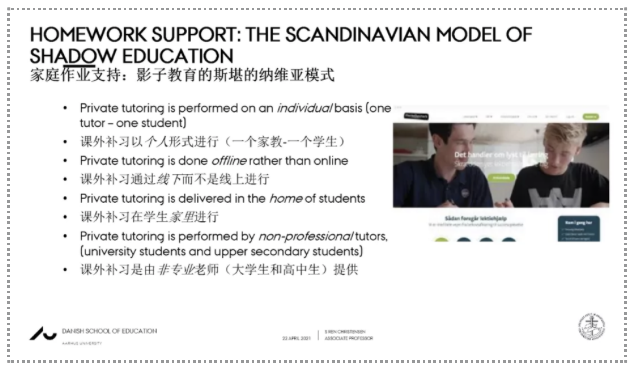
Third, the integration of Sweden, Denmark and Norway has given rise to a unique Scandinavian extracurricular tutoring model, I call it “homework support” model.


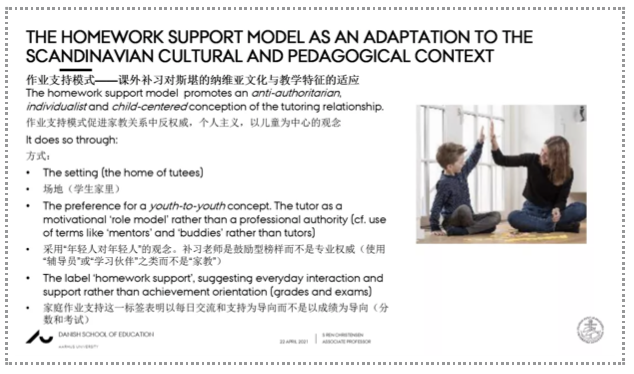
Forth, it seems that we can reach a conclusion that this tutoring model can be explained as the adaptation of out-of-school tutoring to the Scandinavian social and cultural environment.


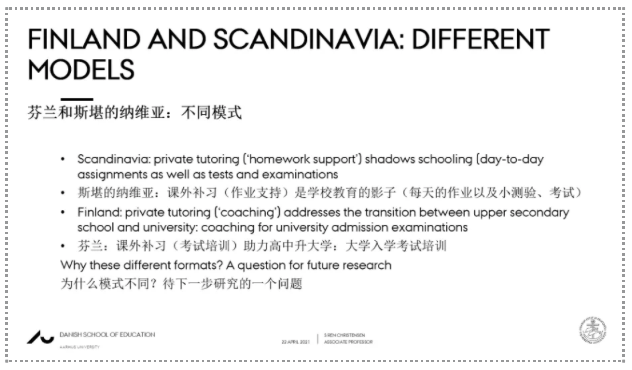
Fifth, The ROE special issue shows that there are important differences in the form of out-of-school tutoring between Finland and Scandinavia. The “homework support” model doesn’t seem to work in Finland.


Whatever the differences in the form of out-of-school tutoring in Scandinavia and Finland, out-of-school tutoring raises the same social and political problems in all Nordic countries. To a large extent, these problems can be summed up by the word “egalitarianism”.

My sixth and final point is about the concept of “egalitarianism”, which also appears in the title of our special issue. In northern Europe, egalitarianism means that equality has important social, economic and cultural values.

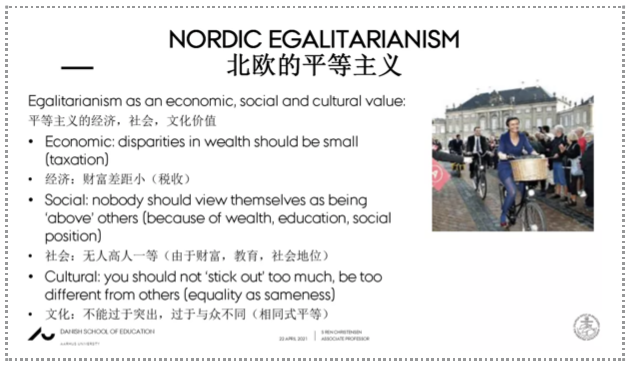

Part of the discussion about shadow education in Nordic countries has focused on concerns that shadow education will erode the egalitarianism of Nordic society. Even parents who buy out-of-school tutoring services for their children have this concern.

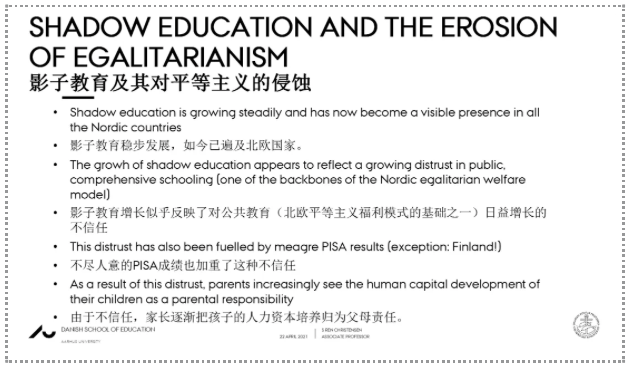
Thus, we may ask ourselves a question: does the rise of shadow education in Nordic countries mark the end of Nordic egalitarianism? I think the special issue of ROE paints a more complicated picture. Our collaborative study found that the Nordic region erodes and maintains egalitarian values at the same time. They point out that due to the steady development of shadow education, it is now evident in all Nordic countries, which in this sense is an erosion of egalitarian values. More importantly, the development of shadow education seems to reflect growing mistrust of public education. This mistrust is also due to the poor PISA scores of all Nordic countries, except Finland. This situation leads many parents to believe that they must take actions on their own to develop the human capital of their children.


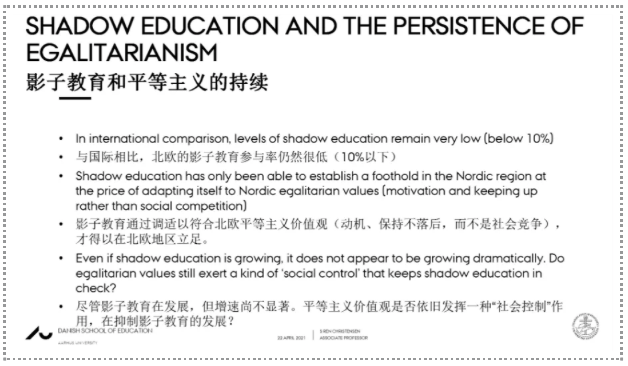
Nevertheless, our research also found the persistence or resilience of Nordic egalitarianism. First of all, don’t forget that compared with international countries, shadow education is still rare in Nordic countries. Secondly, it should be noted that shadow education can gain a foothold in the Nordic environment only by adapting to Nordic egalitarian values. Third, even though shadow education in the Nordic countries is growing, there are signs that the growth is not significant.


In short, the future of shadow education and Nordic egalitarianism is inconclusive, and we don’t know what the answer is. However, with the emergence of shadow education in the Nordic region, I hope I can let you know what the question we are asking ourselves is.
This is the end of my speech. Thank you again for the invitation and thank you very much for your attention.

 Address: 3663 Zhongshan North Road, Shanghai
 Email: ecnuici@163.com
 电话:021-32526084