

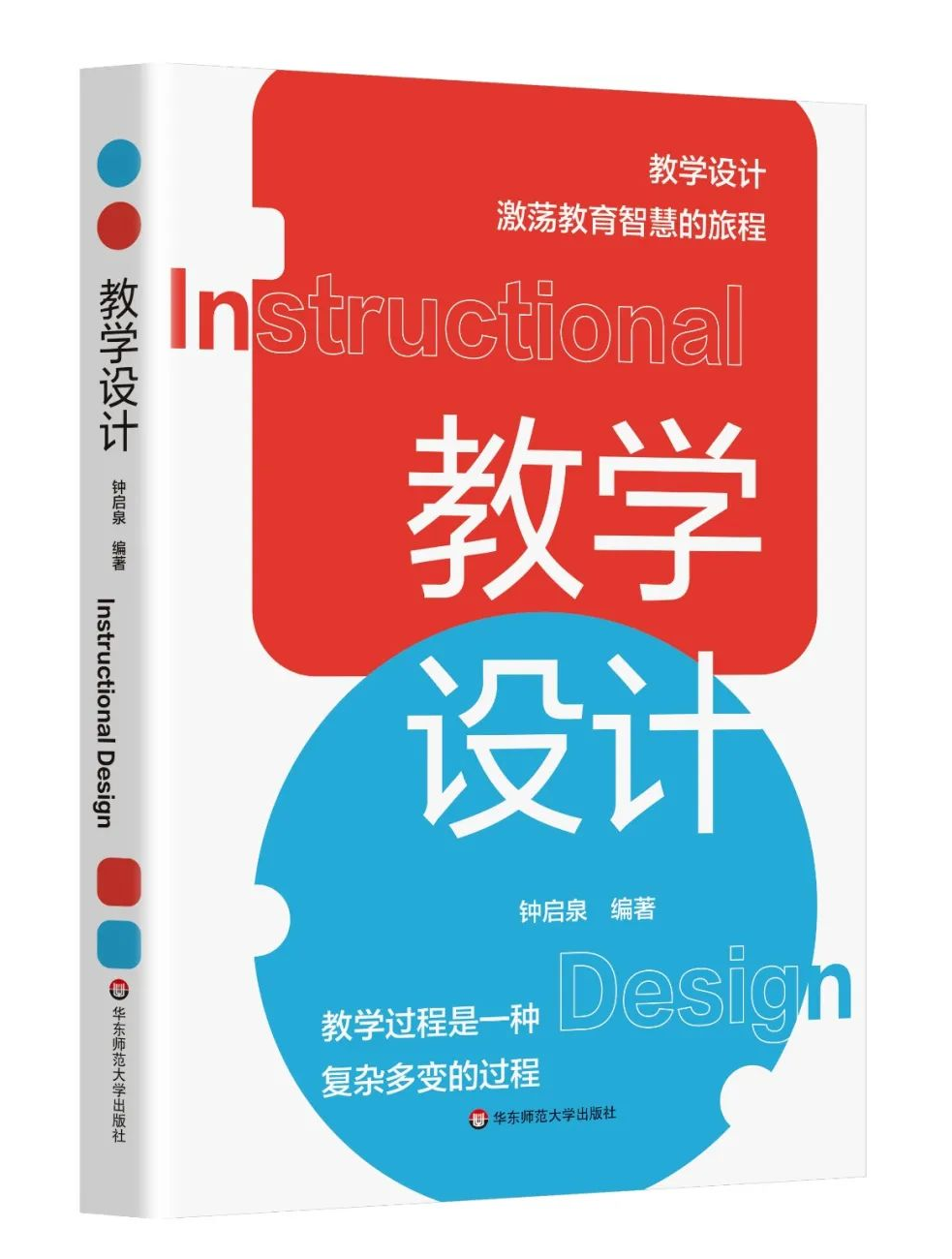
Instructional Design, written by ICI honorary director Pro. Zhong Qiquan, has been officially published by East China Normal University Press.
Author

Zhong Qiquan, a tenured professor at East China Normal University, honorary Director of the Institute of Curriculum and Institution, East China Normal University, member of the Department of Social Sciences of the Ministry of Education (and convenor of the Department of Education and Psychology of the Ministry of Education), member of the National Expert Advisory Committee on Curriculum Materials for Basic Education, member of the Expert Committee on Teacher Education of the Ministry of Education. Editor in chief of Global Education Perspectives.
Brief Introduction
"Instructional design" is an indispensable topic in teacher education and teacher training. Professor Zhong Qiquan's new work "Instructional Design" focuses on the frontier research of international instructional design and aims to sort out the clues of the development of instructional design based on theory and practice. It expounds the recent representative conceptual framework and some typical practices that are valuable for our country's education. It also expresses insights into the modern topics of instructional design. After reading this book, It’s believed that teachers can work out more "effective, efficient and engaging" teaching design in a predictable way.
Introduction: where does instructional design lead?
"Learning" is the cornerstone of the future

Learner-centered Instructional Design
A common problem in the routine instructional design tasks of teachers in our country is that the teaching tasks are simply attributed to "the giving and receiving of knowledge", which is the Instructionism revealed by the learning scientist R.K. Sawyer (2006). In this this Instructionism, knowledge consists of "facts about a correct solution and steps to it," and the purpose of schooling is to fascinate students with these facts and steps. Knowing these facts and procedures, the teacher's job is to impart them to the students. Students start with relatively simple facts and steps, and gradually develop complex learning. The standard and definition of simplicity and complexity, and the appropriate matching of teaching materials are largely determined by the educational administration and subject experts. The so-called success of school education is to enable students to master as many of these facts and steps as possible and participate in the competition for exams. Obviously, the Instructionism can only cultivate excellent "memorizers" at best, and cannot cultivate innovative talents needed in the new era, which is against the trend of the development of the times.

Reigeluth (C. M. Reigeluth, 2017) advocated the five instructional designs of "learner-centered education". First, literacy-based instructional design - learners' progress should be based on learning progress, not learning time. This emphasizes not only qualities such as temperament (attitude, value, morality, ethics) and emotional development, but also the foundation of achievement, including the learning progress of achievement, evaluation of achievement-based learners, and achievement-based learning records. Second, subject problem-centered teaching design——teaching should be centered on the achievement of authentic problems, including projects and problems, information gathering, and learning by doing. However, to accelerate learning and stimulate motivation, teachers must provide scaffolding. The so-called "scaffolding" here means that the difficulty of the task must be adjusted, neither too difficult nor too easy. At the same time, the corresponding information and guidance necessary for learners to complete the subject should be provided as well. Third, teaching design that suits the learners—in order to maximize learning, the design of topics should be in line with the individual characteristics of learners, which vary from person to person, and long-term and short-term goals for teaching are set up; - Topic selection, collaboration, self-regulation, scaffolding, and evaluation are suitable for learners. Fourth, the revolution of roles—to seek the role transformation of teachers, students and technology. The transformation of the teacher's role is manifested in supporting learners' goal setting, supporting learners' own design and selection of teaching topics, promoting the implementation of topics, supporting learning and performance evaluation, and so on. The transformation of the student's role is manifested as an active learner and self-adjusting collaborator, or a learner and an instructor; the transformation of the role of technology refers to the preservation of learning records as a tool to provide learners with the ability to formulate a tool for to guide learning and enable evaluation of deep learning and learning status. Fifth, the reform of the curriculum - the curriculum should be expanded and reconstructed. The true "learner-centered" paradigm should not only pay attention to the cognitive and physical development of learners, but also must pay attention to the important aspects of each learner including emotional, social and personality development. This requires the reconstruction of interdisciplinary courses to achieve "effective thinking, effective action, effective relationship building, and effective achievement".
At the heart of "Learner Center" is the belief that each individual understands and interprets information and experiences in their own way. Whether it is innate DNA or acquired "experience", each has its own uniqueness. Therefore, there are differences in the individuals’ ways of reception, perception and thinking. The theoretical basis of this belief is cognitivism, constructivism, and anthropocentrism or cognitive theories such as information processing theory, schema theory, and mental model, which provide each learner with information based on existing experience and knowledge as well as the basis for processing information in their own styles. Constructivism is based on the belief that "knowledge does not exist outside the learner, but is constructed subjectively and individually", which has become the theoretical basis of learner-centered education. The constructivism of J. Piaget and L. Vygotsky advocates that when learners participate in learning-oriented social communication, they achieve balance and knowledge construction through experiencing, agreement, assimilation and adaptation. Therefore, instructional design should support learners' deep engagement in rich conversations about the implications of authentic topics that facilitate learning for each learner. C. Rogers, a representative figure of anthropocentrism, advocated that the role of the therapist is not only to be able to discover the ideal self based on the expectations of others, but also to guide learners to fully develop their potential abilities.
Compared with the "teacher-centered" instructional design, the "literacy-based" instructional design is the unit design of student learning activities, that is, how to make students participate in the journey of knowledge construction and problem solving. In short, the former refers to the teacher's "teaching", and the latter refers to the student's "learning". Borrowing from Sato Gaku, the former is designed based on the "step-step" approach of "goal-achievement-evaluation", while the latter is designed based on the "mountain-climbing" approach of "theme-inquiry-expression". The teaching design of "literacy-based" focuses on organizing activities of "Explore", "Express" and "Exchange", which are the so-called "3E activities". This instructional design has the following basic features:
1. Authenticity—emphasis on learning in real situations. Students obtain meaningful learning, and then construct their own knowledge.
2. Autonomy—students learn in an active, enjoyable, and interested way.
3. Motivation—teachers use motivation and feedback skills to stimulate students' motivation and interest in learning and make them actively participate in learning activities.
4. Challenging— students face, accept, and undertake challenges, and learn satisfactory and successful experiences.
5. Cooperative— a good atmosphere of social interaction in the teaching process is established. Students are encouraged to cooperate with each other, and achieve teaching tasks.
6. Reflective— students are encouraged to think critically through various situations or questions, so as to understand the reasons and solutions behind the problems, and at the same time to reflect on themselves and continue to improve their learning.
Piaget said, "The principle goal of education in the schools should be creating men and women who are capable of doing new things, not simply repeating what other generations have done; men and women who are creative, inventive and discoverers, who can be critical and verify, and not accept, everything they are offered.” It can be said that the "soul" of "literacy-based" teaching design is to use the "learner-centered" teaching paradigm to cultivate students to become excellent "thinkers" and "inquirers", rather than “memorizers” of ready-made knowledge.

 Address: 3663 Zhongshan North Road, Shanghai
 Email: ecnuici@163.com
 电话:021-32526084