

On the morning of December 30, 2022, Dr. Wang Zuowei, researcher of Educational Testing Service, was a guest of the 4th webinar of the International Classroom Analysis Series and gave a report on the topic of "The impact of reading on children's vocabulary and Reading Speed".

Report Review

Doctor Wang Zuowei's main research interests include English reading tests and English reading development. In this seminar, he mainly introduced the development of children's reading ability when they read books. Based on ETS's listening and reading e-book platform Relay Reader, his research tracked the changes in American elementary school students' reading fluency when reading novels, and designed a targeted vocabulary test to explore the vocabulary accumulation of students while reading. This report first reviewed the existing research on the reading development of elementary school students in the United States, introduced the ETS listening and reading platform Relay Reader, proposed research hypotheses through theoretical calculations, and analyzed the data of Relay Reader to reveal the changes in students' reading fluency and vocabulary while reading.
At the beginning of the report, Dr. Wang shared how, as a father, he observed and thought about the process of children learning English. As a researcher on English reading ability, Dr. Wang has a certain understanding of the reading level that students need to achieve in different grades, but he does not understand how reading teaching in American schools is carried out. Therefore, with the opportunity of home learning, Dr. Wang observed and recorded the reading teaching process in American elementary schools. Instead of providing textbooks and homework, the school requires students to read for at least 20 minutes after class every day, complete the reading record form with the help of parents, and hand it in a month later. At the same time, Dr. Wang tested the children's reading ability, and found that after such reading, the children's reading ability is at the upper middle level of the second grade, which is relatively good.
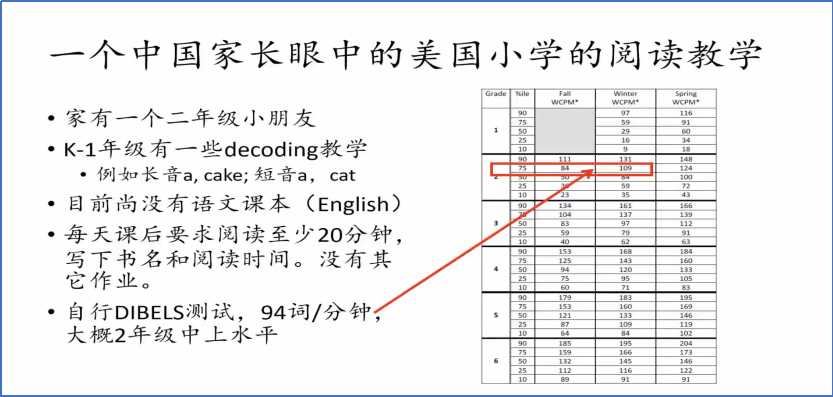
In addition, when reading different language versions of the same set of books, children can read the English version better and gain a deeper understanding. It can be seen that reading 20-30 minutes of English every day can effectively help students develop their English reading ability.
It was these observations in life that ultimately led to Dr. Wang's research questions.
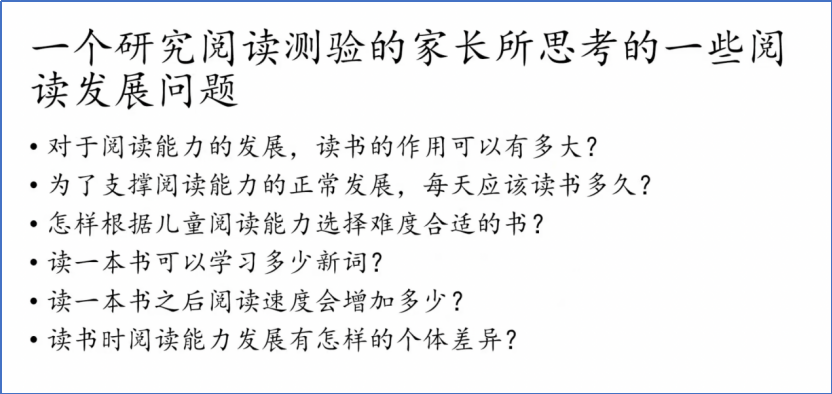
Dr. Wang also shared the vocabulary development process of American students from kindergarten to grade 12. Studies have pointed out that American high school graduates know about 30,000-50,000 words, and students learn about 2,000-3,000 new words each year.

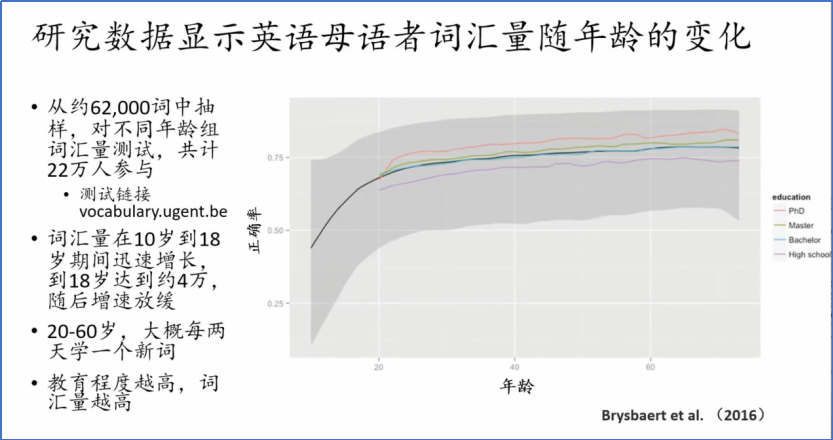
Research data also shows that vocabulary changes with age. Vocabulary grows most rapidly between the ages of 10 and 18, and people between the ages of 20 and 60 learn a new word about every two days. The amount of vocabulary increases with the level of education.
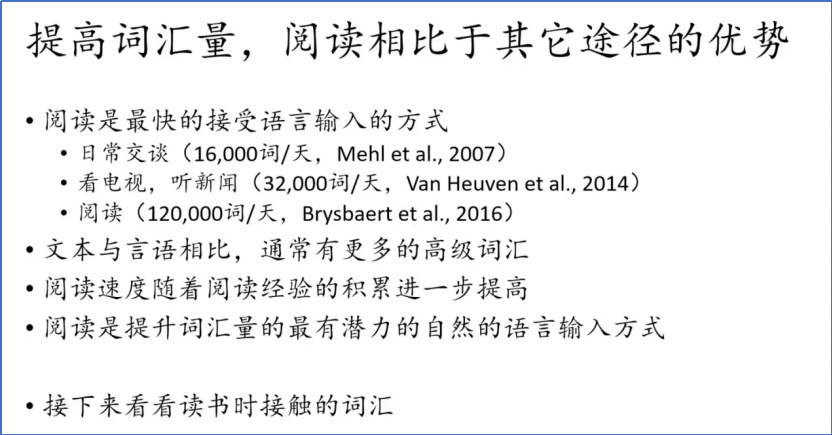

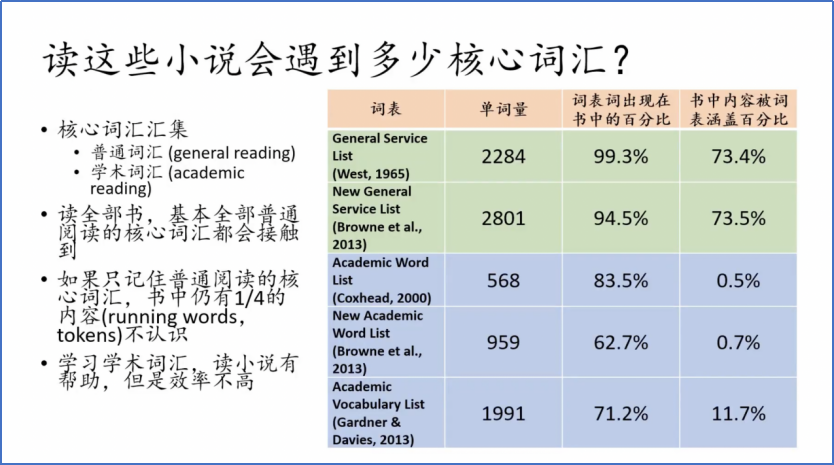
Therefore, research needs to identify which new words American elementary school students in different grades will encounter when reading, and how these new words will affect students' reading. Existing studies have conducted vocabulary tests on students, and marked about 44,000 words and suitable grades.
The study found that with the rise of grades, the density of new words decreased rapidly. From the perspective of improving vocabulary, the best new word density when reading is about 5%.
Based on these studies, Lexile matches the difficulty of the books to the reading ability of the students, and finally recommends appropriate books. ETS's Text Evaluator provides free English text difficulty analysis and recommends appropriate grades based on difficulty levels.
In addition to vocabulary volume, reading speed/fluency during the reading process will also affect reading ability.
For English-as-native-language adults, silent reading speeds are approximately 260 words per minute for fiction and 238 words per minute for non-fiction. For American students, the development of reading speed is not the same in different grades.
Dr. Wang pointed out that many American elementary schools use reading fluency to measure the development of students' reading ability, including indicators such as reading speed, accuracy and rhythm. The evaluation of fluency can use measurement tools and establish common models. They exhibit several features, including significant individual differences, significant intra-year growth, and "summer regression" phenomena.
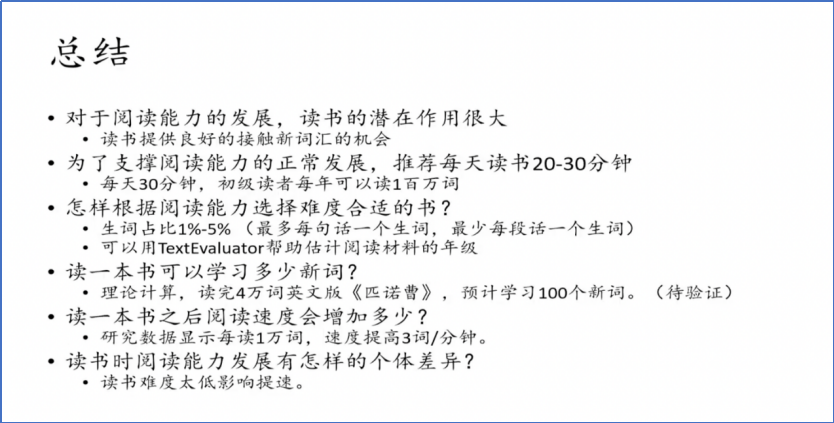
Dr. Wang made a summary of the above content from the vocabulary development of American K-12 students, the selection of reading content and methods, and the selection of evaluation tools. He further pointed out that reading for half an hour a day means that a student is exposed to about 1 million words a year, and the reading speed will increase by 25 words per minute, which is an increase of about 2,500 words per year.
Dr. Wang also introduced Relay Reader, an audio-language e-book reading platform developed by ETS. The platform can integrate listening and reading, assist students to improve reading fluency, and realize reading comprehension monitoring and automatic scoring.
With the help of Relay Reader, Dr. Wang's research team completed statistics on the reading of "Harry Potter and the Sorcerer's Stone" by 86 students. This group of students read a total of 1,136 different short passages in the book, and the average correct rate of reading comprehension was 76%.
The results of the research show that students' reading fluency has been significantly improved in the process of reading "Harry Potter", and the reading speed has increased by 3 words per minute for every 10,000 words read.
Research also shows that, due to individual differences, there are differences in the developmental paths of students' reading speed. Students who read faster in the early stages of reading had fewer changes in speed. In order to carry out further research, the researchers designed a new research idea based on the vocabulary grade calibration table, divided the students into an experimental group and a control group, and further analyzed the influence of individual factors and text factors on learning new words.
Dr. Wang concluded that reading books can greatly promote the development of reading ability, and reading provides a lot of opportunities to know new words. Through reading, students' vocabulary and reading speed will be developed rapidly. Dr. Wang recommends reading for 20-30 minutes a day. Individuals should choose reading materials with moderate difficulty (about 1%-5% of new words) according to their own situation.

 Address: 3663 Zhongshan North Road, Shanghai
 Email: ecnuici@163.com
 电话:021-32526084