

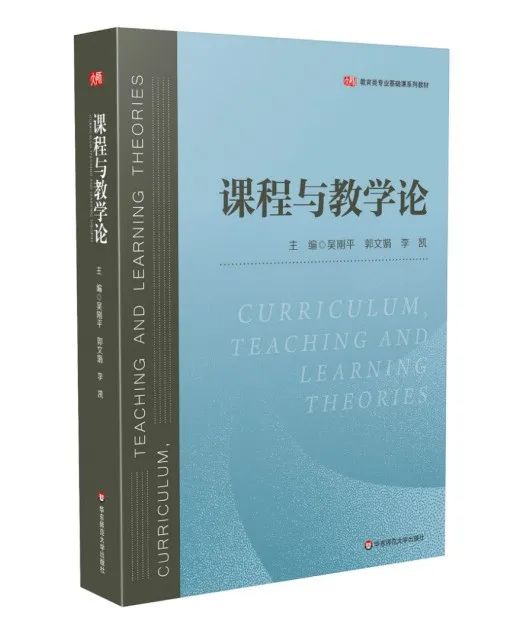
ICI professor Wu Gangping's new book, Curriculum, Teaching and Learning Theories, is officially published by East China Normal University Press.

Wu Gangping, ICI professor
Curriculum, Teaching and Learning Theories is a professional basic course in the curriculum system of teacher education . This book includes the basic principles, basic concepts and basic theories of curriculum and teaching (such as educational philosophy, curriculum understanding, constructivism, reflective teaching , effective teaching, differentiated teaching, developmental evaluation theory, etc.), international development trends and the basic concept and practice of the new curriculum reform of basic education in China, curriculum planning and design, curriculum implementation and curriculum evaluation, teaching design, teaching process, teaching mode, teaching method and teaching evaluation. It also, especially from the perspective of teachers' professional learning, takes the three elements of student-program-teacher and their interactive relationship as the main story line. The book chooses what primary and secondary school teachers should know and do under the background of basic education curriculum reform, integrates with the latest research results in the field of curriculum, teaching, evaluation and teachers, and combine teachers' professional learning methods to comprehensively and emphatically present the curriculum and teaching theory topics, practical cases, problem discussions and reflection, extended reading materials, etc. All of these help constituting a professional study book with theoretical thinking and practical value. This book can be used by undergraduates, graduate students, and in-service teachers.
Highlights
01
As a textbook for the study of curriculum and teaching theories, this book focuses on core literacy, reflects the cutting-edge research results of curriculum and teaching, and integrates the latest curriculum plan ideas for primary and secondary schools.
02
After five years of polishing, ten revisions of the draft, and three additions during the publication review, it highlights the latest academic progress of ICI team in the curriculum reform, "new basic education" practice, curriculum understanding, curriculum resource development, and interdisciplinary theme learning activities, classroom observation, classroom interaction, video empirical studies, teaching evaluation, etc .
03
In terms of writing style, it goes beyond the classic Chinese and foreign versions of the existing curriculum and teaching materials, breaks through the conceptual system and theoretical framework of commonly used textbooks, adopts a discourse system close to educational practical experience, strengthens the integrity of curriculum and teaching, and explores the solutions of theoretical and practical issues .
04
In terms of content presentation, easy-to-understand text expressions are used, accompanied by colorful charts and cases. It discusses the four major educational practice issues of curriculum and teaching planning, implementation, evaluation, and governance. It explores the macro, meso and micro level of actions and forms a two-dimensional integrated analysis framework with extremely distinctive features.
Features
Curriculum, Teaching and Learning Theories aims to enable pre-service teachers or in-service teachers to systematically understand and master the basic concepts, basic principles and basic theories of curriculum and teaching, to understand the development trend of basic education curriculum and teaching reform in developed countries in the world and the basic concept and practice of the implementation of the new education curriculum in China. It helps clarify the new concepts and theories of contemporary curriculum and teaching, and assist teachers mastering certain basic knowledge and basic abilities of curriculum and teaching implementation and evaluation, establishing the awareness of teaching reflection and teaching research, and laying a solid foundation for the future effective engagement in the teaching in the basic education stage as well as for their professional development.
In writing, this book follows the cognition basis and action logic of curriculum and teaching, and tries to construct a textbook discourse system and presentation that connects curriculum and teaching practical problems and cultivates the core literacy of curriculum and teaching. This book strives to:
First, highlight the issues of curriculum and teaching practice.
Curriculum and teaching are the central work of school education. From the perspective of the action process, the main work mainly includes the four major educational practical issues of curriculum and teaching planning, curriculum and teaching implementation, curriculum and teaching evaluation, and curriculum and teaching governance. Planning, implementation, evaluation, and governance are an action continuum, constituting the main line of action. Each of them, in a unique way, jointly answers the fundamental question of education-- "who to be trained, how to train, and for whom to train".
They all can be decomposed into a number of more specific topics and problems, and the corresponding core links and key concepts are gathered to form a framework around this educational practice issue. From the framework and discourse system, teachers are inspired solutions and operational strategies for practical problems in curriculum and teaching. The core knowledge and key technologies thus formed are not only the summary and refinement of curriculum and teaching practice experience, but also the necessary knowledge base for the improvement of curriculum and teaching practice.
In addition to the four major issues of educational practice, it is complemented by two awareness issues of curriculum and teaching introduction, curriculum and teaching research outlook, aiming to provide a better understanding of the four major educational practice issues of curriculum and teaching planning, implementation, evaluation and governance. This also means that a benign interactive relationship of mutual clarification and mutual promotion should be realized between the theory and practice, thought and action, statement and practice of curriculum and teaching.
Second, strengthen the awareness of curriculum and teaching integration.
From the perspective of the history of the development of education disciplines, the curriculum and teaching experience the process of integration, differentiation, and re-integration. In the current context, curriculum and teaching are not only differentiated—they can be two independent research fields, but also integrated—they are closely linked organic whole. However, as far as curriculum and teaching materials are concerned, curriculum and teaching are firstly a whole. Only through the observation of the overall perspective and continuous strengthening of the awareness of integration can we better understand and deal with curriculum and teaching, especially the four major issues of educational practice, namely planning, implementation, evaluation and governance of curriculum and teaching , and the inner connection and basic principles of the alternate operation of separation and connection, differentiation and integration in different contexts.
Third, adopt a discourse system that is close to the practical experience of education.
This textbook breaks through the conceptual system and theoretical framework ideas commonly used in curriculum and teaching theory textbooks, and uses basic topics and discourse framework ideas instead. This is because basic topics and discourse framework are relatively more inclusive, closer to practitioners who are easier to absorb educational practical experiences, especially those from the curriculum and teaching reform innovations of front-line educators. These experiences and achievements should become the source of curriculum and teaching theories.
Curriculum and teaching theories need to absorb the world's advanced educational theoretical achievements, and at the same time need to be based on Chinese educational practice and incorporate more practical discourse on Chinese educational reform and innovation. The idea of adopting basic issues and topic frameworks is not denying the significance of conceptual systems and theoretical frameworks, but precisely to highlight the theoretical orientation close to educational practice, reduce the mystery of curriculum and teaching theories, and open up the channels through which more practical experiences can be summarized and condensed into practical theory to enhance the practical explanatory and guiding power of curriculum and teaching theory.
Fourth, focus on horizontally and vertically dimensional integration analysis technology.
In the field of curriculum and teaching, the four major educational practice issues of planning, implementation, evaluation, and governance constitute the horizontal dimension of the knowledge base of curriculum and teaching, and then form a horizontally related and interactive content theme structure. The three action levels of macro, meso and micro constitute the vertical dimension of curriculum and teaching knowledge base, and then form a vertically connected upper and lower hierarchical structure. Through the cross-integration of horizontal and vertical dimensions, it focuses on specific issues, topics and problems of curriculum and teaching, constructs a discourse system to explain specific issues, topics and problems of curriculum and teaching, and explores solutions to curriculum and teaching theory and practical problems.
This two-dimensional integrated analysis technique is not intended to provide fixed conclusions, but to seek a way of thinking and inquiry methods in order to establish disciplinary thinking in curriculum and teaching research, and to find out the practical breakthrough of curriculum and teaching. With the help of this two-dimensional integrated analysis technology, when learning and exploring curriculum and teaching theories, teachers don’t have to stick to rigid abstract concepts, neither do they memorize the knowledge, but can independently transform and self-construct the basic concepts of curriculum and teaching and discourse system.
Fifth, release the autonomous space for disciplinary inquiry.
In terms of specific content presentation, this book is based on the principle of enhancing awareness and improving actions, and takes the awareness and practical issues of curriculum and teaching as the main line, and sets up six major categories of curriculum and teaching: introduction, planning, implementation, evaluation, governance, and outlook. There are fifteen chapters in total. Each chapter roughly consists of three sections: one is the initiation of learning section, which involves content guides, introductions, cases, etc. ; the second is the section on mastering core knowledge and key technologies, which involves discourse analysis, principles, and principles of cognitive and practical issues. The third is the extended learning section, which involves important concepts, discussions and reflections, extended reading, frontier hotspots, etc. Each section emphasizes the selection of perspectives for topic analysis and the application of two-dimensional integrated analysis techniques, based on which the discourse expression of specific topics, themes, and problems can be developed, and a referential curriculum and teaching knowledge foundation can be provided for learners. Moreover, it can effectively release the autonomous space for subject inquiry, and promote learners' autonomous learning, cooperative learning, and inquiry learning.

 Address: 3663 Zhongshan North Road, Shanghai
 Email: ecnuici@163.com
 电话:021-32526084