

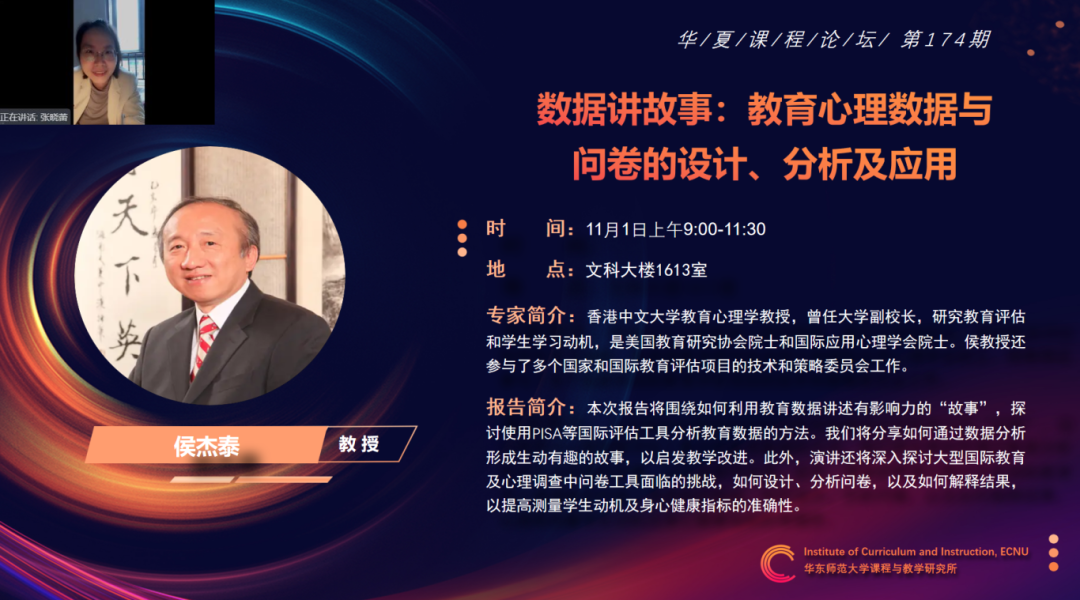
This report was hosted by Associate Professor Zhang Xiaolei from the Institute of Curriculum and Instruction of East China Normal University. Professor Cui Yunhuo and Associate Professor Liu Junyan from the Institute of Curriculum and Instruction of East China Normal University, Associate Professor Liu Yuan from the Department of Psychology of Southwest University, Dr. Xiao Leifeng from the Department of Psychology of Shanghai Normal University, and 455 teachers and students from inside and outside the school participated in the report online.

📓 Questionnaires should use data-based and behavioral questions as much as possible
📓 Question statements should be as simple, specific and short as possible
📓 Students' responses should be as multivariate normally distributed as much as possible
📓 Question statements should be described in natural language as much as possible
📓 Balance the use of positive and negative questions in questionnaires
Then, Professor Hau explained questionnaire design (such as the five-point scale) and the controversy surrounding it. He specifically mentioned the problems and risks in the actual use of questionnaire tools, such as students and teachers guessing the "better" answers, and further pointed out the limitations of questionnaire data collection. Finally, Professor Hau gave opinions and suggestions on the careful handling of negative questions in questionnaire compilation with examples.
After the report, Professor Hau Kit Tai had a full exchange and discussion on the Big-Fish-Little-Pond Effect, the intra-group and inter-group effects in educational statistical analysis, and the problems in questionnaire compilation encountered by the participating teachers and students.


 Address: 3663 Zhongshan North Road, Shanghai
 Email: ecnuici@163.com
 电话:021-32526084