

On the afternoon of November 28, Professor Zhou Yong delivered an academic lecture titled "The Shift in National Education and Curriculum Reforms in the Last Six Years of the Qing Dynasty" as part of the university's anniversary celebrations. The lecture was hosted by Associate Researcher Yang Chengyu from the Department of Curriculum and was well-attended by faculty and students from both within and outside the university.
In 1905, the Qing court abolished the imperial examination system and established the Ministry of Education. The goal of the late Qing educational reform shifted from cultivating a small number of Western-oriented talents to nurturing "the majority of the populace" for national reconstruction. This required significant adjustments in curriculum design, teaching content, and the education system. The core reforms included: first, integrating the "five key qualities of citizenship" into school curricula; second, promoting universal education and improving the infrastructure of national education. However, factional struggles within the Qing court and conservative thinking hindered the smooth progress of these reforms. Particularly after 1908, when the Qing court adhered rigidly to the policy of "loyalty to the emperor and respect for Confucius," it failed to win public support, leading to the ultimate failure of the reforms.
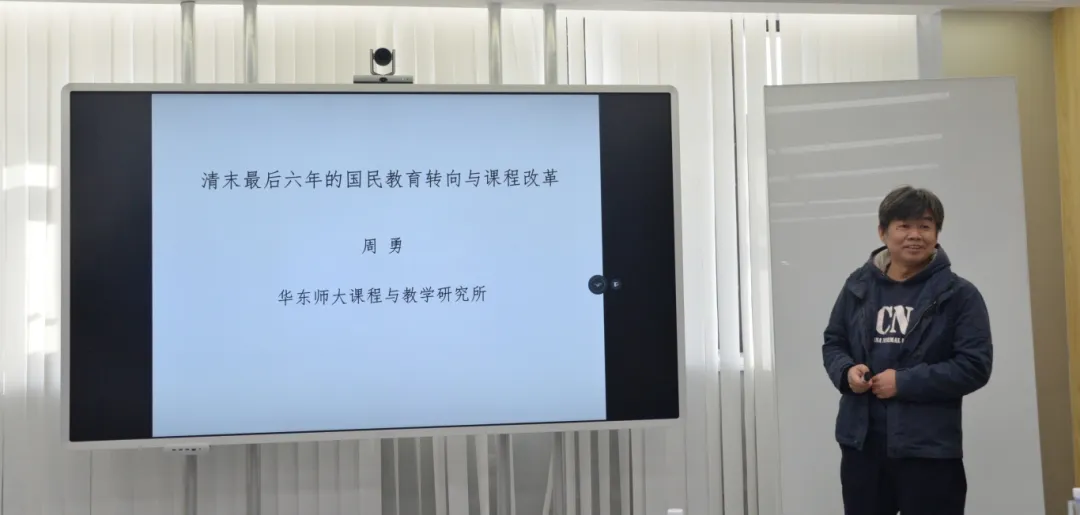
Professor Zhou Yong analyzed this historical process through several dimensions:
1. From "a Few Talents" to "the Majority of the Populace"
In 1901, the Qing court restarted its educational reform. Due to internal factional disputes, Zhang Baixi’s efforts to reform the education system were thwarted, and Zhang Zhidong took over. After the abolition of the imperial examinations in 1905, Yuan Shikai's faction gained prominence in the Qing education sector. Yan Xiu, who became a key figure in curriculum reform after the establishment of the Ministry of Education, played a pivotal role in shaping and advancing the reforms. Thanks to Yan Xiu’s vision and negotiation skills, the late Qing curriculum reform formally adopted a significant shift toward national education, aiming to transform “400 million people” into “citizens” through systematic curriculum changes.
2. Five Key Qualities of Citizenship and Curriculum Reform
Yan Xiu proposed the "five key qualities of citizenship"—loyalty to the emperor, respect for Confucius, public-mindedness, martial spirit, and practicality—as the guiding principles for curriculum reform. To implement these ideals, Yan Xiu developed two pathways:
1) School Curricula**: Loyalty to the emperor and respect for Confucius were taught through classical courses, while public-mindedness, martial spirit, and practicality were promoted through practical subjects such as science, handicrafts, and physical education.
2) Teacher Training**: Officials and teachers at all levels—from the Ministry of Education to local education departments—were expected to lead by example and serve as role models for students.
However, severe shortages of educational resources in local areas and uneven standards across schools limited the effectiveness of these measures. Additionally, power struggles within and outside the Qing government further complicated the implementation of national education reforms, making the process fraught with challenges.
3. Losing Public Support: The Later Stages of Curriculum Reform and Its Failure
In 1907, Zhang Zhidong entered the Grand Council and took charge of the Ministry of Education, shifting the focus of curriculum reform back to "loyalty to the emperor and respect for Confucius." Later, under Zaifeng’s regency, Yan Xiu and the Yuan Shikai faction faded from influence. Tang Jingchong was appointed to lead the Ministry of Education, initiating a new phase of curriculum reform designed to support the preparation for constitutional monarchy. However, because Zaifeng’s constitutional plans lacked popular support, the later stages of curriculum reform not only failed to deepen the earlier goals of national education but also fueled anti-Qing forces. Eventually, revolutionaries overthrew the Qing dynasty and the Ministry of Education. Yet, the task of completing the unfinished work of national education and curriculum reform fell to the revolutionaries, who entrusted Cai Yuanpei with the responsibility. Under his leadership, national education and curriculum reform took a new direction, emphasizing foundational liberal arts and sciences alongside aesthetic education.
Through this report, Professor Zhou Yong guided faculty and students in exploring the complex context and challenging process of late Qing curriculum reform, offering a broad historical perspective for deepening research on the history.


 Address: 3663 Zhongshan North Road, Shanghai
 Email: ecnuici@163.com
 电话:021-32526084