

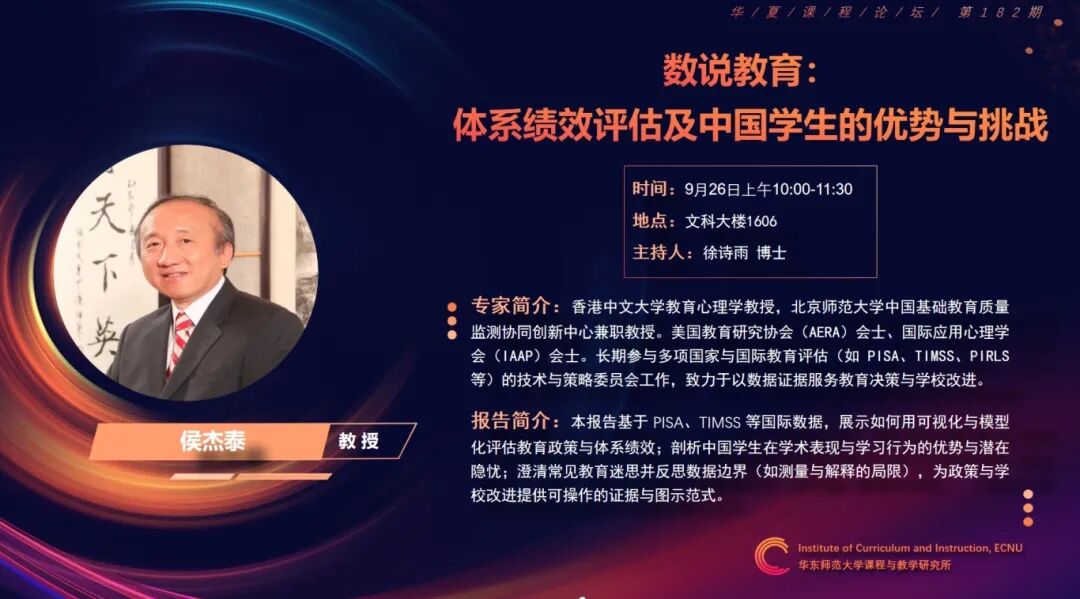
On the morning of September 26, invited by the Institute of Curriculum and Instruction (ICI), Professor Hau Kit-Tai from the Department of Educational Psychology at The Chinese University of Hong Kong (CUHK) returned to the ICI Huaxia Curriculum Forum. He delivered an insightful lecture titled "Education by the Numbers: System Performance Evaluation and the Strengths and Challenges of Chinese Students."
The session was chaired by Dr. Xu Shiyu (Chenhui Scholar). Key faculty members and students, including Yang Chengyu, Zhang Xiaolei, and Chen Ye, attended the seminar to engage in learning and exchange.
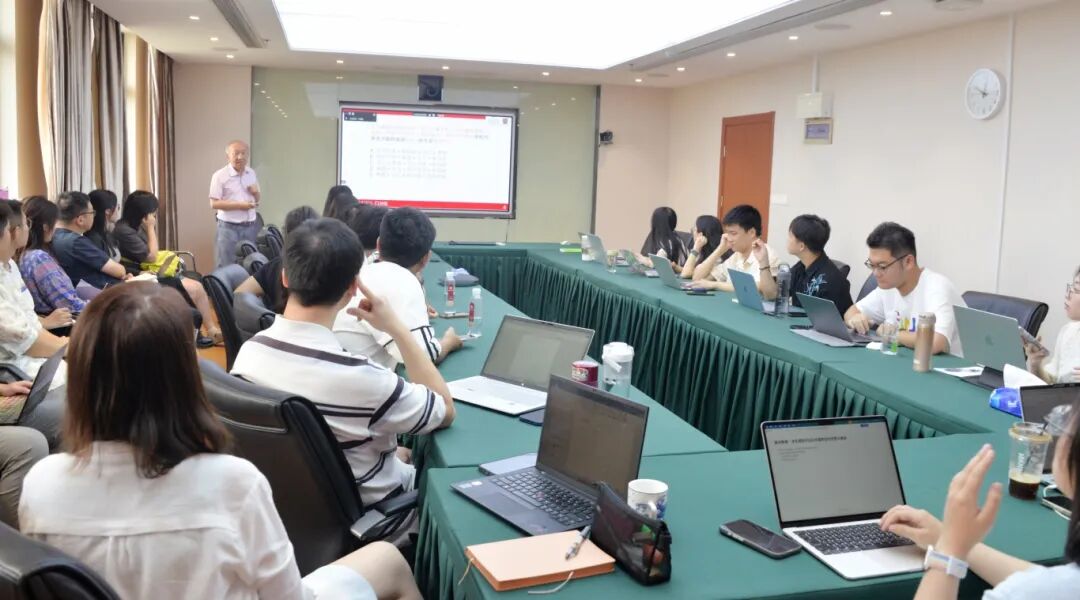
Drawing on authoritative international data sets such as PISA and TIMSS, the lecture explored core issues including educational equity and resource allocation. Prof. Hau systematically demonstrated how to scientifically evaluate educational policies and system performance using visualization and modeling methods.

Global Perspective: Prof. Hau began by analyzing the academic strengths and potential issues of Chinese students using international assessment data. He emphasized that educational data reveals its true value only when placed in a cross-national/regional comparative perspective, identifying data visualization as a key method for revealing differences and supporting research and decision-making.
Methodological Rigor: Prof. Hau addressed common myths in educational research, stressing the need for a scientific and prudent attitude in critical stages such as questionnaire design, data adjustment, and conclusion inference. These empirical reminders provided actionable evidence and practical paradigms for the precise optimization of educational policies and the effective improvement of school teaching.
Contextual Analysis: Concluding the lecture, Prof. Hau connected the findings back to the reality of Chinese education. Focusing on science education and innovation education, he provided a deep analysis of the strengths and weaknesses of the Chinese education system through an international comparative lens.
During the Q&A session following the report, faculty and students participated enthusiastically. Prof. Hau engaged in a lively discussion with the audience on practical strategies for quantitative questionnaire design and data analysis.


 Address: 3663 Zhongshan North Road, Shanghai
 Email: ecnuici@163.com
 电话:021-32526084