

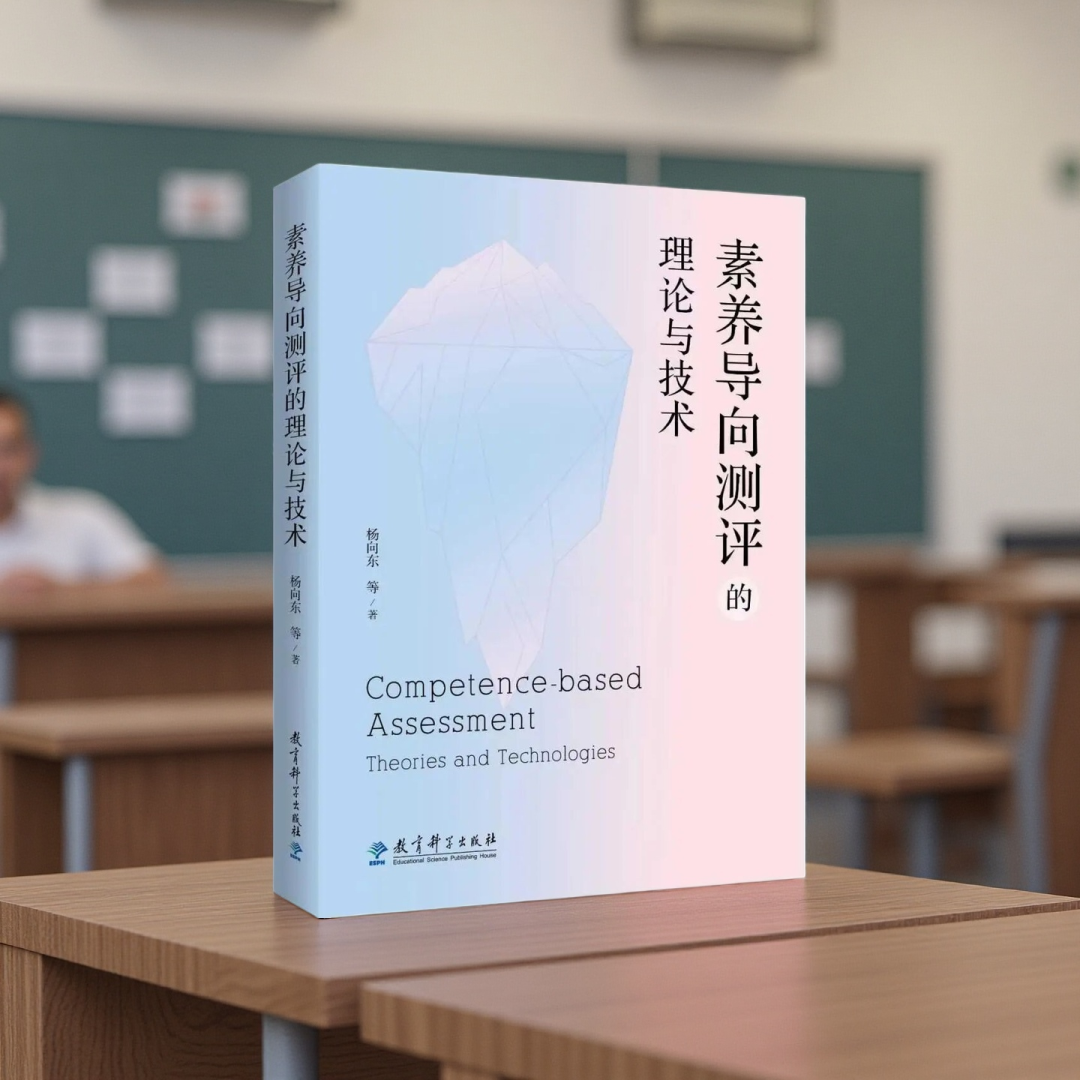
To address the pressing need for evaluation reform under China’s New National Curriculum Standards, Professor Yang Xiangdong—a senior research fellow at the Institute of Curriculum and Instruction (ICI), ECNU—and his research team have officially published their highly anticipated monograph, Theory and Technology of Competency-Based Assessment (Educational Science Publishing House).
The book marks the culmination of years of collaborative research funded by the National General Project of the 13th Five-Year Plan for National Educational Science (Grant No. BHA200132), titled "Research on Competency-Oriented Embedded Assessment Systems." It provides a comprehensive, end-to-end solution for core competency testing—spanning theoretical models, assessment paradigms, and algorithmic psychometric techniques.
Biography: Professor Yang Xiangdong

Prof. Yang Xiangdongis the Chair of the Department of Educational Psychology, Professor, and Ph.D. Supervisor at the Faculty of Education, ECNU, and a senior research fellow at ICI. He holds a Ph.D. in Psychometrics from the University of Kansas and previously served as a researcher at the Center for Educational Testing and Evaluation at KU and an Assistant Professor of Educational Psychology at Indiana University Bloomington.
Professor Yang is a leading national expert in educational measurement. He serves as Vice Chair of the Basic Education Evaluation Committee of the Chinese Society of Education (CSE) and was a core expert in the comprehensive revision panel for China's National Compulsory and High School Curriculum Standards. He has published over 100 peer-reviewed papers in prestigious domestic and international journals (including Psychometrikaand Acta Psychologica Sinica) and has led over 10 major national grants funded by the National Natural Science Foundation of China (NSFC) and the Ministry of Education.
The Challenge: Moving Beyond Rote Memorization
In 21st-century basic education, evaluating student competencies rather than simple rote knowledge retrieval has become a global imperative. Historically, traditional high-stakes exams have struggled with a structural bottleneck: an over-reliance on fragmented knowledge and standardized multiple-choice items.
To bridge this gap, Theory and Technology of Competency-Based Assessment integrates Principled Assessment Design (PAD), performance-based assessment, learning progressions, and Item Response Theory (IRT) modeling. The book is structured into five core sections that transition seamlessly from foundational theory to practical implementation:
Part 1: Psychometric Foundations
Part 2: Structural Architecture & Modeling
Parts 3 & 4: Subject-Specific & Interdisciplinary Pilots
Part 5: Teacher Literacy & Moderation
Core Research Breakthroughs
1. The "Iceberg Model" of Core Competencies
Rather than treating competencies as isolated skills, Professor Yang introduces a localized, multidimensional "Holographic-Hierarchical" Competency Model. By analyzing cross-cultural frameworks, the book maps out competencies across individual field practices, socio-cultural activities, and anthropological milestones. This structural design is synthesized into an "Iceberg Model" of Competency, illustrating how surface-level student behaviors are anchored by deep-seated conceptual understandings and cognitive values.
2. Shift to Principled, Evidence-Centered Assessment Design
The monograph breaks away from traditional, intuition-driven test item writing. Grounded in Principled Assessment Design (PAD), it champions an integrated, theory-driven, and evidence-verified paradigm. By converting item design into a hypothesis-testing process driven by construct theory, psychometrists can control the exact cognitive components and difficulty variables embedded within a test item, ensuring exceptional construct validity.
3. Realizing Embedded Assessment in Routine Classrooms
Embedded assessment is the ultimate mechanism for achieving the integration of teaching, learning, and assessment. The book uses structured curriculum content as a mediator to deliver a scalable model for everyday classrooms:
Dimensional Clarity: Establishes clear metrics across two primary axes: Subject Conceptual Understanding and Subject Practical Capacity.
Learning Progressions: Features concrete task exemplars and learning progression tracks across physics, geography, and science curricula. This allows tracking student progress across different themes and educational stages.
Teacher Assessment Literacy (TAL): Outlines frameworks to diagnose and improve teachers' data literacy through collaborative evaluation moderation mechanisms.
Field Implementation and Institutional Scalability
The models detailed in the book have already been rigorously piloted across multiple laboratory schools in Shanghai and Zhejiang. By refining the embedded assessment architecture against real-world regional datasets, Professor Yang’s research group has established a highly reproducible, ecologically valid framework. This book serves as an invaluable roadmap for international researchers, local policymakers, and school administrators striving to build resilient evaluation networks for the future of schooling.

 Address: 3663 Zhongshan North Road, Shanghai
 Email: ecnuici@163.com
 电话:021-32526084